December 26, 2011
“Live and Let Live“
This interview was originally conducted in Russian. This is an AI-generated English translation.
 - Lyudmila Evgenyevna, during our first conversation, you said that there are times when culture rises and when it declines, that culture, like a person, changes its qualities and facets. Did they show up in any way over the past year and a half?
- Evolution is a slow process, even if it is not about biological evolution, but about cultural phenomena. A year and a half can not be considered as a significant period of time.
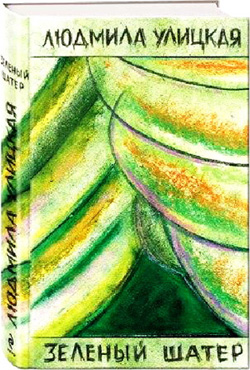
On the novel The Green Tent:
- You said that in order to preserve a person, it is necessary to make individual efforts. The characters in your book are trying to do just that. But why didn't you let any of them survive? Should this be understood as the impossibility of remaining a free and decent person in an unfree society?
- Have you ever had a situation in your life where everyone survived?
- We are not talking about a family saga, but about a narrative that fits into a period of forty-three years - from the day of Stalin's death to the day of Brodsky's death. Moreover, I do not mean all the characters, but the three main characters – Miha, Ilya and Sanya.
- Even those of my heroes whose deaths are not described will die; so will the author.
And today's readers. Moreover, decent people, scoundrels, and even there is no certainty that the good and beautiful will die an easy death, and murderers and villains will suffer for a long time. Green tent is a place where everyone meets regardless of their personal qualities and deeds. This last equality is nothingness. Regardless of the regime, place of action and era. But your reading is also possible.
- In the Soviet years, there was a dissidence – a democratic movement opposed to the government. In fact, it was a struggle not so much for freedom of conscience, speech, personality, as for the preservation of their own human dignity. Is there a movement like the dissident movement in modern Russia? Where does this confrontation manifest itself?
- Today it is different: there is a large queue of people seeking to sell this very sense of human dignity for an inexpensive fee. Nothing, live without it and do not even notice the loss.
- It seemed to me that the novel “Green tent” is a kaleidoscope of stories from the life of Russian intellectuals. After reading it, one comes to the disappointing conclusion that the intelligentsia, in its essence, is a class of lonely people who are equally uncomfortable both in dangerous proximity to the authorities and in the crowd. In turn, both the authorities and the crowd do not like them either and are treated, depending on the situation, at worst - hostile, at best - with mockery and ridicule. How does the current generation of intellectuals differ from the generation of their parents?
- There is no such generation of intellectuals. There have always been individuals who have little capacity for group association. There are so few of them that recently a friend and I discussed the need for one car or one train to send all intellectuals to Magadan or where the authorities decide. I thought it was a car, and he thought it was a train. There is no question of a generation.
About Khodorkovsky:
- This spring, while in England, you told reporters:
" Khodorkovsky is in prison because society is intimidated. This loss of dignity upsets me because our society has only just begun to overcome fear after so many years of repressive rule. Fear has once again begun to engulf the Russian people.”
Fear of what or who did you mean? Maybe this is not fear at all, but banal indifference?
- Fear of not being able to share the cake.
- Do you continue to correspond or otherwise maintain relations with Mikhail Borisovich? Are there other people specifically trying to help him and is there any hope (given the recent castling of Putin-Medvedev-Putin) that M.B. will be released before 2014?
- No, I do not maintain relations with Mikhail Borisovich. But there is still some connection. I am a member of the board of trustees of the wonderful institution he founded fifteen years ago. He founded this lyceum for the children of the dead soldiers, and now there are orphans and children from single-parent families of all kinds (not only from the military). There I spoke today with his parents, Marina Filippovna and Boris Moiseevich. Today in the Lyceum "Moscow" was held Lyceum holiday. I try not to miss these holidays because it is the best thing to see in our country: wonderful children, wonderful teachers, beauty and joy. Thank you to Mikhail Borisovich! This is the last of his projects that were not taken over by the authorities.
The logic of our power is such that it is hard to imagine him being released. It greatly interferes with them in any capacity, and the further, the more.
- In publishing the correspondence with Khodorkovsky, you hoped that “our sleepy and lazy society will understand”tHow much of a lie this trial will see is the degree of absurdity of what is happening.” Why, despite all the evidence of this absurdity, does Mikhail Borisovich not elicit support or even sympathy from most Russians?
- I don't think so. Public opinion has long leaned toward Khodorkovsky. Unfortunately, that doesn’t change anything about his fate.
– Has your personal relationship with Khodorkovsky changed?
Mikhail Borisovich is a statesman, my views on this subject are different. But one thing he convinced me was that I believed we lived in a strong totalitarian state. His view is that the state is weak, and this is what causes a strong repressive mechanism within it. I agreed with him.
My attitude towards Khodorkovsky has also changed. I entered into correspondence with him to give him an opportunity to speak out: a large part of society was against him. I was aware that he had been chosen as a political target, where, according to the organizers of the process, the age-old hatred of the poor against the rich should have been directed. But it didn't work. In the most difficult circumstances, he showed courage, self-esteem, wit, if you will.
- I read that Khodorkovsky became a scientific consultant to journalist Olga Romanova, who with his help is preparing a philosophical work on the topic “Russian prison: the experience of freedom”. When asked why each new government canonizes martyrs who suffered under the previous government, Mikhail Borisovich said that the reason is the seizure or transfer of power without regard to the law. What would you answer that question?
- I didn't know about it, but I'm sure it will be very interesting. The experience of Olga Romanova, whose husband has just been released from prison, and the experience of Mikhail Khodorkovsky, who, unfortunately, is still serving his indefinite sentence, will undoubtedly provide an interesting study.
- And yet, why in Russia historically do not like wise men, but honor martyrs and fools?
- What kind of martyrs are revered in Russia when the beloved people’s saint Alexander Nevsky? Read his life and understand who the people worship! Fools in the 18th year, the authorities killed whom they transplanted. I specifically researched this material, even the play was written by “Seven Saints from the Village of Brukho” – on documentary material, among other things. The authorities respect only cruel and senseless force, its heroes Dzerzhinsky, Zhukov. Not to mention the criminal founding fathers of the Soviet state. Not martyrs of power are needed, but ideological icons, and this product is quite difficult – in our time neither Pavlik Morozov nor Alexander Matrosov can do. So our power has neither a hero of our time nor a national idea – it does not suck out of the finger.
- Can Khodorkovsky’s book about his prison experience be popular in Russia today, and should he try to write such a book?
- He is writing this book in small chapters. I'm very happy about that. Unfortunately, the fate of Russia is such that the topic of crime and punishment,
Prisons are a fundamental theme of Russian literature. Dostoevsky, Tolstoy, Korolenko, Chekhov, Solzhenitsyn, Shalamov and further everywhere - to Limonov. Such is Russia, such are its sore spots and testimonies about the life of almost a million Russian prisoners are very important. Whether it will be popular does not bother Khodorkovsky or me. Anyone interested will read it. Publishers' earnings don't bother me much.
On tolerance:
- What is tolerance in your understanding and where should be the boundary that defines it?
- Live and let others live – one formula, and the second – do not do another.
What you don’t want from others. Wisdom is so simple and so old that I do not understand why or what spears break!
- In theory, the Internet contributes to the unification and, therefore, mutual understanding of people, and they, on the contrary, become more divided, it becomes increasingly difficult for them to hear each other, understand and agree. Why do you think this is happening?
- The Internet has not changed the face of the world, it is just one sign of change. Loneliness and disconnection are unlikely to have any positive or negative correlation with technological progress. It seems to me that these are phenomena from different ranks. As for the problem of understanding and/or misunderstanding, I believe that in the twenty-first century there is a huge breakthrough in this field: people have become more universal, and a pop culture that few highly educated people like has provided a wonderful new cultural platform for mutual understanding: the music of the Beatles, snickers, jeans and hamburgers from McDonald’s represent a very good cement for gluing the new world humanity. I’m fine without all of the above things, but they and others like them will ultimately help the Turks, Kurds, Israelis, Arabs, Serbs and Albanians come to terms. Today’s icon is an advertisement for the Beneton store. And it's a very good icon.
On literature:
- All of your books have become bestsellers in the good sense of the word. Do you often hear compliments and feedback from your colleagues on your creative success? Do you care about their opinion?
- Reviews of colleagues – a special specific weight, regardless of whether this is a good word pronounced by a writer I like, or to the work of which I am quite indifferent – do not have. But a good word is especially valuable because it's hard not to measure up and compete. The writing community is pretty bad. I prefer artists as a creative community. I am married to an artist, and the world of his colleagues is much more attractive to me. As for the reviews of my books, and any, and in general: smart criticism is better than stupid praise. That's for sure!
– Are you generally offended by negative responses?
- Sometimes it's very interesting. Sometimes a misunderstanding or an angry tone is angry, but in general I am interested in criticism.
- Are you re-reading your previous texts?
- Just in connection with the transition to another publishing house, I re-read everything that was published. It was a lot of work.
Have you been invited to the jury of literary competitions?
- I rarely agree to that.
- If you were the chairman of the Russian Booker in 2010, would you award the prize to Elena Kolyadina for the novel “Flower Cross”, which she herself, by the way, called “galimatia about the fiery eel and golden blades”?
- I haven't read this piece. Russian Booker was given for such weak books that this award completely lost its status among readers. And the saddest thing is that she was not given for books that are really outstanding: there is no Booker Prize at Lyudmila Petrushevskaya! She is a writer of great talent.
- Which books have impressed you recently? (positive or negative)
- I have no negative impressions – I close the book first. I recently learned how to do this and am happy with this achievement.
It is with great pleasure that I read Mommsen. No wonder he received the Nobel Prize, a wonderful work.
- After the book "Green tent" You said you wouldn't write any more novels. What caused this decision?
- Tired.
- What are you working on now?
- Another interview. I'm sick and tired, too.
- What to do, interviews are an integral part of popularity. Good luck and inspiration. Thank you for agreeing to be a guest of Circuit.
Zoya Master
You can read an interview with L. Ulitskaya.