May 26, 2011
Diplomatic Dictator
This interview was originally conducted in Russian. This is an AI-generated English translation.
Help:
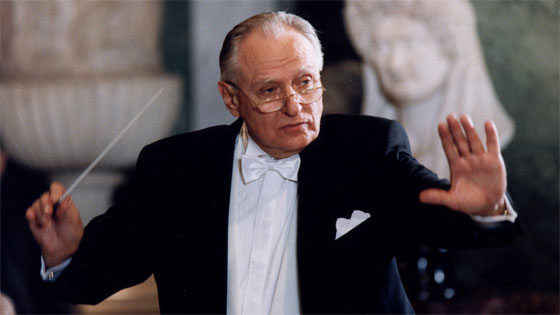
Conductor. People's Artist of the USSR (1980), laureate of the State Prize of the USSR (1987), National Prize of Lithuania (1999), etc. President of the Hermitage Academy of Music Foundation. Born in Šiauliai (1928). Graduated from the Vilnius Conservatory (1952) in violin (A. Livontas); since 1977 – professor. Conducting was improved by I. Markevich. He headed the orchestra of the Ciurlionis School of Arts (1955) – a gold medal at the G. von Karajan Youth Orchestra Competition (Berlin, 1976). He founded the chamber orchestras of Lithuania (1960) and the “Camerata St. Petersburg” (1989; since 1994 – the orchestra of the State Hermitage Museum). Chief Conductor of Patras (Greece, 1999-2004). Principal Guest Conductor of the Moscow Virtuosi Chamber Orchestra (2004). Member of the jury of the largest international competitions: including Tchaikovsky (Moscow), Mozart (Salzburg), Toscanini (Parma), as well as the Karajanov Foundation (Berlin) and others. He performed with GASO of Russia, with the Philharmonic Orchestras of St. Petersburg, Berlin and Toronto, as well as with the National Orchestra of Belgium, the Orchestra of Radio France and other groups in Russia and abroad. He conducted the ballet Othello to the music of A. Pärt and A. Schnittke (Salzburg Festival, 1988), as well as the operas The Magic Flute and Orpheus and Eurydice (Mariinsky and Hermitage Theatres, 1994).
- Can you name the three most important events in your professional life?
- My life was and is filled with many important events, so it is quite difficult to single out one or three at once. But the first thing that comes to mind is winning an international youth orchestra competition in West Berlin in 1976. Then the orchestra of the musical school named after Ciurlionis, which included students aged 12-17 years, was the best, although the performers were the youngest of the contestants. Of course, the awarding of the Gold Medal by Herbert von Karajan, the recognition of our work by a world-class jury, played a huge role in my career and, accordingly, in the career of the orchestra. Immediately after the competition, we received many invitations from reputable concert organizations: from New York, Paris. But in Soviet times, everything was decided in Moscow, and these invitations remained on paper.
Speaking about the recent past, I would mention the awarding of the title of Honorary Professor of the St. Petersburg Conservatory in 2006.
- Thirty years after that contest.
- Yes, well, if you asked me to name three, then each premiere of the works of contemporary composers also became a real event. Now these authors have become classics – I’m talking about Alfred Schnittck, Arvo Pärt and many others. The first performance is always a huge responsibility, and when a piece is successful and then goes on with its life, it is very joyful.
- Let's go back to 1976. When Karajan presented you with a gold medal, he said, “If young people play like that, there’s nothing to worry about for the future of music.” And today, thirty-five years later, could you repeat his words with the same certainty?
- It is difficult to imagine the highest level of training of musicians. In particular, I am talking about Moscow and the Moscow Conservatory. After all, it was impossible to leave the country, and all the best people wanted to go to the capital. Only from there you could get to international competitions and then build a career. In Moscow lived and performed world-class musicians: Kogan, Oistrakh, Rostropovich, Richter, Yankelevich, Gilels, Nikolaev – all and not listed. The traditions of the Russian school continued. After the departure became free, the students of these great musicians began to teach in the best educational institutions in the world. Of course, this is a loss for the country, but the level of teaching, which means that the level of skill of young musicians is very high.
- In connection with the G. von Karajan Competition, I would like to ask whether there are competitions of such a high level today.
- If you mean international chamber orchestra competitions, no.
- What's the reason?
- Money and only money. Then ten orchestras were selected from all applicants for participation in the competition, which paid for both the road and the full content. That's a lot of money. There's no such thing now.
- Was there a prize fund?
- No, we didn't get a cash prize, but the prestige of the contest was more important.
- A year ago, I had the opportunity to interview Mark Gorenstein (head and chief conductor of GASO them). E.F. Svetlanova – approx. Z.M., in which he noted that the system of training orchestral musicians has not changed for the better, that with a decrease in the number of musicians willing to work in the orchestra, the number of orchestras has increased disproportionately and, consequently, the level of orchestrators has decreased. He also said that today, the training of instrumentalists is aimed at a solo career, despite the fact that the ability to play in an orchestra requires several other skills, which, unfortunately, are not given due attention in the conservatory. Do you agree with that view?
- I am well acquainted with Maestro Gorenstein. In this case, his statement seems to me a bit categorical. But I can agree with him that orchestral training of instrumentalists should be given special attention, because not everyone is destined for a solo career, and it is one thing to be a soloist, and another to sit at the remote control. But on the other hand, having a sense of the ensemble, and playing as the conductor wants, you still need to be able to perform your part masterfully. And if you do not raise a bright soloist, then he will not be taken into a good orchestra. So, first of all, a musician should be an excellent performer, and it is easier to educate ensemble skills than to teach him to own an instrument.
- I noticed a strange thing: as an honorary professor at the St. Petersburg Conservatory, you do not teach in Vilnius. Why?
- I am a violinist by training and spent 27 years in charge of the chair of string instruments at the Vilnius Conservatory. I came into my career as a conductor through pedagogy. I have organized the work of specialized music schools in Lithuania, following the career of musicians from their earliest age. It's also pedagogy.
- Absolutely. But there's a strange trend. Svetlanov was not allowed to teach conducting, Gorenstein, a student of the wonderful teacher Arnold Katz, for reasons similar to Svetlanov’s, also, Spivakov, performs concerts and still does not educate a new generation of conductors. But you yourself have just noted the importance of tradition, the continuity of generations, what is called a school.
- What to do, the generation has changed, and there are no such teachers as, say, Leningrader Nikolai Rabinovich. But conducting is a very strange, secret profession. Conductors are not made, they are born. There are things you can't teach. A conductor must have certain inherent qualities that cannot be nurtured.
- Like what?
- For example, the ability to lead a team, which includes confidence in your own understanding of the music being performed and the ability to convince yourself that you are right.
- So an exceptionally gifted but modest, shy, self-doubting musician can never become a successful conductor?
- You put the question too categorically, and I prefer shades. But probably not, because dictatorship is inevitable. And any successful conductor would agree with me.
- What's the shade then?
- Perhaps the conductor will have some phenomenal musicality and this, figuratively speaking, will bribe the orchestrators. But still he must firmly know what he wants and not let himself be confused, because if he shows the slightest uncertainty, doubt - and he will destroy his own work.
- Sometimes musicians of such a high level sit in the orchestra that they seem to be embarrassed to make remarks. How did you deal with this, especially at the beginning of your career?
- Dictatorship must be flexible and conductor diplomatic.
- That's your style, right?
- Yes, I try to find an approach to the musicians and remember that it’s not me, it’s them. My task is not only to demand, but to explain clearly the plan. It is important to motivate, but not to humiliate. You can and should be strict for inattention, slackness. But I make delicate remarks about performance, so people don’t lose faith in themselves. Unfortunately, a rude tone is common in our country, but in America, as far as I know, it is unacceptable. They speak correctly.
- Yeah, lawyers don't sleep here. So you have to watch yourself.
- I get it. Although educated, intelligent people tend to control themselves not for fear of being sued, but simply because of certain moral principles. Humiliation can kill creativity, especially in young musicians.
- They say that the memory of wrongdoing is more durable than the memory of good deeds. If you think about the disbandment of the famous Lithuanian Chamber Orchestra, which you created and led for 44 years, in 2004, how do you see the whole story seven years later?
Yes, it was a great offense, and I remember it.
- At one time, your orchestra was no less famous than the orchestra of Rudolf Barshay. He toured a lot, and in the international “ranking table” was very high. What was the reason for such a strange decision on the part of the leadership?
- The fact is that the true cause is still unknown to me. The orchestra was not even disbanded – it was liquidated. You see, my orchestra, the symphony orchestra, the choir, and other Lithuanian chamber ensembles used to belong to one organization, the State Philharmonic. She also had a huge staff of administrative workers - 140 people, relics of the Soviet system.
In America, this is impossible to imagine. I had to go through endless instances on all matters, especially financial ones. And in the end, it became unbearable. In order for each team to build its line depending on its budget, a reorganization was necessary. I began to fight, and, in principle, got my way, but at the same time I got into a big conflict with the Ministry of Culture. And the obstructions started.
- So the orchestra fell victim to bureaucracy?
- It turns out so.
- How did you and your musicians actually become unemployed?
- I found out from the paper. Since June 18, 2004, the Lithuanian Chamber Orchestra has been liquidated. At the same time, I was not released from my job, because my five-year contract at that time had not yet expired, so there was no right to dismiss. But if the orchestra is abolished, then automatically I am no longer who I was. They paid me half a year’s compensation and settled down.
- Seneca said, “The resentment of those in power should not only be endured patiently, but with a cheerful face: if they think they have really hurt you, they will certainly repeat it.” Have you forgiven the offense? When you meet those people, say hello, do you give a hand?
- I am so educated that I say hello, but I do not support relationships. It's all so stupid. After all, soon after the disbandment, there was a new orchestra with the old name, many of my musicians behind the consoles. The band celebrated its 50th anniversary last year and didn’t know how to celebrate. I am alive, leading an active creative life. In short, they put themselves in an awkward, even stupid position.
- You often travel to Russia, not only because you have been leading the Hermitage’s St. Petersburg Chamber Orchestra for 21 years, but also for various festivals and concerts. Do you have any regrets about the collapse of the Soviet Union? After all, it probably broke old cultural ties and impoverished the concert life of Lithuania.
- The respect and friendship between cultural figures remain the same, the audience goes to concerts and warmly welcomes us – in Russia, Russian musicians – in Lithuania. Although, of course, cultural exchange is not as rich as in the past, but there are several reasons. One of them is the high fees of celebrities. However, only this year came Nikolai Lugansky, the Moscow trio, in June will perform Vladimir Spivakov with his symphonic orextro. When I came to Russia, I never felt or felt hostility. In general, in my opinion, there are no anti-Russian sentiments in Lithuania. I do not regret that Lithuania became independent. Of course, we have a lot of corruption, injustice, untapped human resources, and not everything is going as smoothly as we would like. But if something goes wrong with politicians, it doesn’t necessarily mirror people’s relationships.
- I wish everyone was internationalist.
- When I talk to someone, I don’t think about their nationality. I'm much more interested in his personality. By the way, you know, my father was awarded the title of Righteous Among the Nations, his name is immortalized in Yad Vashem.
- Come on! Tell me more.
- He was a major public figure, mayor of Šiauliai. During the war, his deputy, the vice-burgomaster, was shot by the Germans, and the family fell into the ghetto. They managed to escape, and my father helped them survive – for a year and a half he hid them from relatives in a farm. The saved boy is my friend, professor-theaterist Markas Petukhauskas, director of the Vilnius Jewish Culture Club. He advised me to send the documents to Jerusalem. After three years of consideration - there are very carefully checked all the facts - already posthumously, the father received a medal and a certificate of honor. He died in 1989 in Boston. And in Lithuania, also posthumously, he received the Order for saving the dead. We have such a beautiful and honorable award.
- As far as I know, the only state that does not award state awards to people recognized as Yad your righteous of the world is Russia. In fact, according to 2010 data, only nine of the 164 Russian righteous survived.
But let's go back to the music. In one of the interviews, you were called “the conductor of the first row”. What does this mean and by what criteria is this “row” built?
- The criteria for skill are career and fees. Conductors of the world's leading teams - masters of the first rank, the very first row. This is R. Mutti, D. Levine, Z. Meta, K. Mazur, etc. If we talk about the post-Soviet space, then, of course, V. Gergiev, Y. Temirkanov – in St. Petersburg, V. Fedoseev, Y. Simonov, G. Rozhdestvensky, Mark Gorenstein – in Moscow. Vladimir Spivakov is a musician and conductor of the highest class, who at one time created the Moscow Virtuosi orchestra, and then brought up a first-class symphony orchestra. These are stars of first magnitude. Although it happens that a conductor who did not get into the leading orchestra, has no less talent and also works miracles with his team. So the scale of skill in this case is very relative.
- As far as I know, you have not only creative but also friendly relations with Vladimir Spivakov. After all, he was very supportive of you during this whole dissolution of the orchestra.
- It is. By the way, then many famous Russian musicians appealed to the government of Lithuania, protesting against the dissolution of the orchestra: Temirkanov, Minin, Pletnev, Rozhdestvensky. And Volodya Spivakov also wrote an official letter in which he asked me to become the main guest conductor of the Moscow Virtuoso. It was not only an honor but also a moral support. It's a very honorable position. I perform with them several times a year. Recently we gave concerts in Nizhny Novgorod, St. Petersburg and Moscow. Zakhar Bron and his two young students, Mone Hattori and Sayong Yong, played with us. And Monet is only 12 years old, and she made an incredibly strong impression on me. I've never seen anything like that. This, by the way, says Zahar Bron himself. And it is not only in technique, but also in depth, expressiveness of sound, temperament and understanding of the music performed. I thought it was the second Yasha Heifetz.
- Since you mentioned Heifetz, I have to ask you this. The composer Boris Borisov, who once studied in your class and later became a professor at the Vilnius Conservatory, told me about how you searched for and found the house in which Heifetz once lived. Could you share some details of this story?
- Sure. Well, the fact that Yasha Heifets was born in Vilnius, everyone knows. The house where he was born no longer exists. But the house where he lived was preserved, but few people knew about it. It was shown to me back in the 50s by violinist-concertmaster of the Vilnius Symphony Orchestra Samuel Bernstein. And it was from him that I learned what was remarkable about this house in the Old Town, which had previously not attracted my attention. As time passed, Lithuania became more open, and foreigners began to come to us. Many of them were interested in the period of Heifetz’s life associated with his years spent in Vilnius, and they wanted to see some memorable places. The orchestra came from Holland. They were very surprised that no one could show them the house in which this world-famous violinist lived, a genius who has no equal yet. I showed them and a lot of other people that were interested. And then, in the new master plan of the city, I saw that this house was to be demolished and something else would be built in its place.
- Do you remember what it was?
- Electric battery station. In general, I began the struggle and reached the 1st Secretary of the Communist Party of the Republic. So the house was saved.
- What about the station?
- It was built in another place, for which it was necessary to demolish part of the hill. But the house is standing.
- Did they hang the plaque?
- Not yet. But it is on the wall of the school where Yasha Heifetz began his education.
- And there was not enough money for two boards...
- No, it's just that historians are beginning to question whether the house is the wrong one. And the controversy continues. Although back in the 80s, I sent a photo to Heifetz himself - through a man entering his house. And Heifetz admitted it. Then Robert Heifetz came here, to whom I also showed the house where his father lived. Here's a picture from The New York Times and an article about the whole story. I must say that in the early 90s the Yasha Heifetz Foundation/Society was established in Vilnius. I was its president and Professor Borisov was its chairman. Now, in connection with the events that we talked about, I retired from business, and everything somehow came to naught. Although we managed to celebrate the 100th anniversary of Heifetz very well. This year it’s 110 years old, but nothing happens.
- I wanted to talk about repertoire and, in particular, contemporary music. The view that 20th-century music is far more difficult to perceive than classical or romantic music hardly needs an argument. Gathering full halls on modern music is almost impossible. As an example, I will cite the recent tour of “Moscow Virtuosos” in the United States.
In the program of the second department, Vladimir Teodorovich included the works of Shostakovich and Schnittke. Later in the Russian press there were reports of a triumphant tour, although in many cities the orchestra gathered far from complete halls - despite the fact that this team has long been sincerely loved by the Russian-speaking public. (English was not very popular due to lack of advertising.) After the concert, many were left confused. Such music is too difficult to perceive and requires serious musical training due to its dissonance. Not every listener is able to appreciate and enjoy the instrumental findings and dodecaphonic delights of a brilliant, but difficult to perceive “unprofessional ear”. Schnittke even in a stunning performance of “Virtuosos”. (Music, on the other hand, is an elite art.) And as a result, most likely, some of the loyal fans of this band will miss his next tour if they see the names of modern composers in the concert program. On the other hand, the path taken by some well-known performers who descend to the tastes of the “mass” is even more destructive. How do you build your repertoire and how do you feel about 20th century music?
- This is a very serious issue, and I agree with you that the program should be addressed to the listener, and when compiling it, one should represent this or that audience. Of course, it is impossible and unnecessary to please everyone. And again, you are right about the fact that modern music is difficult to assemble. But there is a contradiction here: If only classics are played, critics and journalists will reproach the conductor with retrograding - they say, outdated, does not keep pace with life, is not able to appreciate new sound, new ideas. However, new music is often such that the ear is not perceived, and therefore the soul. Now you will write all this down, and others will pick up: Sondeckis is mothballed, stuck in past centuries.
- I’m sure they won’t, because everyone who is even slightly familiar with the repertoire of your orchestras knows that many of the premiere performances of modern composers owe it to you. The same Schnittke dedicated several of his works to you, including the famous Concerti Grossi #1 and #3, Arvo Pärt – Tabula rasa.
- In my opinion, modern music has gone the wrong way. Back then, in the early 20th century, the Schoenberg-Webern system seemed like a breakthrough, a revolution with a promising future. But now, I think, modern composers have also understood the futility of atonal music, because such music is unnatural. It will be perceived by the mind and not by the ear, and therefore it does not give aesthetic pleasure. But I want to say that among modern music there are very beautiful, bright, emotional works. And if you play for music lovers, you need to choose one, music that would bring joy, not leave in bewilderment. If the audience is more prepared, then you can boldly show innovative works. As for Spivakov’s concert, I understand that he played mainly for people from Russia. And this is a very colorful audience, and I wouldn't experiment on it.
- What is important in your relationship with your colleagues?
- Professionalism and sincerity.
- And if you notice a falsity, do you treat it as irreconcilably as you would a fake note?
- I am dealing with false communication diplomatically. I will not point or expose with my finger, but I will beware.
- What makes you happy today?
- You know, I don't need to look too far ahead. It makes me happy every day I live. I work, conduct important concerts, but I pay more and more attention to the past. There was no time for this before, and the past is getting longer and longer. I have an archive, and I have to think about how these important pages of Lithuanian history, which I was involved in, will be useful for future generations.
Zoe Master was talking.