August 1, 2011
I Live My Life
This interview was originally conducted in Russian. This is an AI-generated English translation.
In August of this year, admirers of Mikael Tariverdiyev celebrated his anniversary – 80 years since the birth of the composer, who died 15 years ago. The name of Tariverdiev is associated primarily with the music for the films “The Irony of Fate”, “Seventeen Moments of Spring”, “The Deer King” – in total, he wrote the music for 132 films. Very often, the age of songs from these films turned out to be much longer than the creative life of the films themselves. So, for example, happened with the song “The Little Prince” – few people remember the existence of the film “The Man from the Equator”, but the song is still loved. All new generations of performers and listeners find in it what modern songs so lack – sincerity, professionalism, that bright nostalgia, from which tears in your eyes, and a sense of happiness from contact with true talent. Unfortunately, a significant part of Tariverdiev’s work is less familiar to the general audience. This “underwater part of the iceberg” – vocal cycles, ballets, operas, concerts for the organ – thanks largely to the selfless work of his widow Vera, gradually takes a well-deserved place in the repertoire of Russian and foreign musicians.
Vera Gorislavovna agreed to talk about the man who became her only love, husband and teacher (Tariverdiev was 26 years older than Vera), about the fate of some of his works, and how the memory of her husband, working with his legacy helps her live.
"I'm living my life."
“He who loves must have the art of losing and finding. ?
(Paulo Coelho)
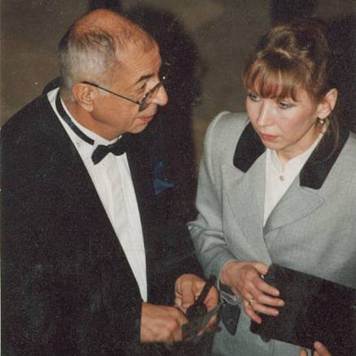 - Vera, tell me about yourself. What family are you from?
- I was born in Almaty. My grandfather graduated from Kyiv Polytechnic Institute and spoke six languages. In Kazakhstan he became one of the founders of the republican publishing house. His wife, my grandmother, a Polish, daughter of an Orthodox priest, who had never worked until her husband’s death (he died under strange circumstances in 1934), began teaching mathematics, became head teacher of the school, and was awarded the Order of Lenin. His father is a journalist, the first doctor of science in this profession in Kazakhstan. Mom's a professor of philology. Students are still learning from her books.
- There were no musicians in your family and you are a musicologist. Did you choose music or did you choose music?
- I hope it was a mutual choice. Our house had an old Becker piano, with candlesticks and ivory keys. Sometimes my father would sit down at an instrument and play some plays. It’s hard for me to say what drew my attention more to music, whether it was my father’s play or the piano itself. From an early age, I wanted to learn music. First I was taken to a private teacher, then assigned to a music school, then I entered music school. The choice of profession took place in those years. Moreover, even then, not even a thought arose in me, but a desire and confidence that I should live in Moscow.
In music school, I dealt with bigotry, which somewhat bothered my parents. For example, for four years, every day, I would come in two hours before class and work on my own to develop absolute hearing.
- Is it possible to develop absolute hearing? Have I always believed that this quality is innate?
- Yes, musical ear can be developed, I have seen this through my own example.
- For myself, I know that to enter the musicology department, you need to pass 11 entrance exams..
- Yeah, that's right. And I entered the Gnesin Institute (the current Gnessin Academy of Music), which graduated with a thesis.
Early Forms of Polyphony in 13th-14th Centuries Music in France
- That is, you were going to continue to do research work, but came to journalism. Any advice?
- Rather, it influenced his passion and professionalism. The education and atmosphere in Gnesinka was amazing. Among other subjects was music criticism, a subject that was led by the editor-in-chief of the magazine “Musical Life” Ekaterina Dobrynina. It was because of her that I wanted to try myself in this profession. A student of my father, professor of Moscow State University Vladimir Gorokhov took me to the newspaper “Soviet Culture”, where I was already in the 4th year of practice, and I was hired. He was a correspondent. The newspaper of the Central Committee of the CPSU did not immediately take people. And I was given a place that was prepared for Irina Andropova (the daughter of Yuri Andropov – author’s note). Her father called the editor-in-chief and said that one member of their family was enough for the newspaper.
- Did he mean his daughter-in-law, Igor's son's wife?
- Yeah. I was just lucky. I became a journalist and quickly learned the skills. She wrote about contemporary music, concert reviews, commissioned and edited articles, while naively arguing with her superiors. At the age of 26, she became deputy editor of the music and choreography department. On a business trip in Vilnius, I met Mikael Leonovich.
- You were 26, he was 52. Half his life. You were married to a classmate, and you already had a son. I read that you quickly became disillusioned with that marriage and called it "absolute evil." Is it your words or journalistic hyperbole?
- Disappointment, yes. And "absolute evil" is hyperbole. How can it be absolute evil that my child came from?
- Your son stayed with his father. What kind of relationship did you have in the future? Has your son forgiven you for not being the main person?
It would be wrong to say that with the appearance of Mikael Leonovich in my life, my son or mother ceased to exist for me. Tariverdiyev became my beloved man, my teacher, the man who determined my fate. As for my son, when I had to make the decision to leave or not, Vasya agreed to move with me. Mikael Leonovich accepted him as his own son. Even in the questionnaire, he indicated that he had two sons. In general, he was amazingly able to communicate with children, boys felt in him that in life is rare. We lived together for a few years and those years were very important for us all. Vasya was with us during the period when Mikael Leonovich was undergoing heart surgery, and he was a very good friend, helping us. Now Vasa is 31 years old, and he believes that the main teacher in his life was Michael Leonovich. The father, who does not need him now, then out of jealousy, out of revenge in every possible way set him against us. As a result, Vasya returned to his father, (although then lived with his grandmother), and now regrets his then decision.
- Does Vasya communicate with Karen, son of Michael Leonovich?
- Not lately. Vasya lived in India for two years, now in Cambodia. Karen has a life, a job, too. He fought in Afghanistan, was wounded twice, now writes stories. We had a period of frequent, close communication. But now I'm more in touch with his daughters.
- How did others react to your affair with Mikael Leonovich?
- People around us did not know about our relationship for a long time. Fortunately, they were secret for a while. It was a relationship between the two that no one interfered with or influenced. In secret relationships, there is that intimacy that is absolutely necessary for people to understand each other, to see each other with their own eyes. Mystery is always romantic.
– Have you “coincided or had to change a lot in your own habits, tastes, lifestyle?”
- I didn't have to change anything about myself. Because I met a person in whom everything was dear to me, everything coincided with my understanding and idea of what a person should be. In short, it was my man. At some point, I changed my place of residence – moved to Mikael Leonovich, and then changed my name. I didn’t really need a close relationship with anyone anymore. Somehow my friends fell away. Everything became common, including close people. Even today it is difficult for me to communicate (and I do not communicate closely) with those to whom Mikael Leonovich is not close, incomprehensible or does not touch. Our friends were friends and stayed. That's what they are friends for. I am very happy that we sometimes get together, they come to our concerts. They treat me very well. Even there are friends from the past of Mikael Leonovich, with whom he has not spoken for many years. And I'm getting to know them now.
- How did your parents feel about this marriage?
- My parents treated Michael Leonovich very well. They loved him as much as he loved them. My father consulted him, my mother adored him. He was like a senior companion to them, even though he was younger. There was a momentary understanding, an instant sympathy. Perhaps this is how it should be – when you perceive a person as a whole, together with his world.
In some ways, our biographies have something in common. Mikael Leonovich is from Tbilisi, he is an Armenian from Tbilisi. My mother taught at school, my father was a bank employee, and was imprisoned in 1949. Like me, he wanted to go to Moscow. I found myself in Tbilisi after his departure and loved this city as my own. I never miss Alma-Ata. But I miss Tbilisi very much. Both cities are multinational, colorful, surrounded by mountains.
– Was there equality in your relationship? For example, did Mikael Leonovich listen to your opinion about his writings? Have you always been able to express your opinion honestly?
- You know, I had no reason to argue with Michael Leonovich. It may sound strange, but no one would argue with him if he came into contact. It seems that our understanding of him was also connected with our understanding of his music. He was counting on me in that sense. When I practically forced him to work on an autobiographical book (I wrote it to his dictation), he was angry and said that I should have written a book about him. That's what I did when the time came. These are the happiest moments of my inner life since he left. Because when I studied his scores, his manuscripts, his notes, I was happy to communicate with him, from an even deeper understanding of him as a person and a musician.
– Tantum cognoscitur, quantum diligitur. (We know as much as we love it.)
I guess so. He liked to show me what he had just written. There was no occasion that I didn't like it. Because Mikael Leonovich never wrote a single superfluous note or an untalented note in his life. It's true. At least that's how I see him.
He was very aware of what he was doing. It was very important to him that I understood his music and his music in general. He was very proud of what I was doing. How I write, how I feel about what I write.
- In the Orchestra Party program You said, "The first faces of music today are not composers, but performers." Let's talk about those and others. Which of the performers M.L. preferred and why?
- Mikael Leonovich created not only his compositional style, but also his performance style. He needed the performers of his manner. He wrote only the music he heard inside. I always say that. But this is not a repetition of one thought. This is a statement of fact, my testimony that how He wrote music. He wrote it, and then he needed a performer. He was looking for him, sometimes brought up, as it was with the duet Besedina – Taranenko, with Kamburova, the trio “Meridian”. He created their manner, or rather taught them his manner. And when he did not find a performer, he sang himself, as it was with monologues on poems by Grigory Pozhenyan, Andrei Voznesensky, Ludwig Ashkenazi, Shakespeare. And no one can perform his monologues on these poems. Only Olga Dzusova is close to this manner.
- After the film “The Irony of Fate”, Tariverdiev asked Alla Pugachev not to perform his songs anymore. What exactly did the author not like in the “post-film” manner of performing the diva?
- He worked for a long time with Alla Borisovna – and in “The Reindeer King”, when she was 19 years old and she had just graduated from the Ippolitov-Ivanov School, and then in “The Irony of Fate”. She and Ryazanov were looking for the right, suitable performer. After all, in "Irony" are not songs, they are romances, very complex and melodically, harmoniously, and rhythmically. They are not easy to perform (except for “If you do not have an aunt” and “On Tikhoretskaya”. And romances on the poems of Tsvetaeva, Pasternak, Akhmadulina are very difficult things. Then Mikael Leonovich remembered about Pugacheva. She was found and taken to the painting. There were rehearsals, there were a lot of takes during the recordings. The result is something that everyone knows and barely recognizes Pugachev. When it was recorded, no one knew it. In the autumn of 1975, she won the Golden Orpheus and became very popular. The picture was released on January 1, 1976. After the success of the film, Mikael Leonovich was invited to the Cinema. And Alla Borisovna, too. Mikael Leonovich believed that she would sing live and he would accompany her. When they tried, nothing remained of the manner in which she sang and which the Tariverdiev demanded of her. And then he asked her not to sing his songs again. It was a different Pugachev and her manner for Mikael Leonovich was alien and unacceptable. That's the story.
- And why did Tariverdiyev, unlike Pakhmutova, Babajanyan, not write songs for Magomayev?
Mikael Leonovich, with rare exceptions, did not write for anyone. He sometimes dedicated works – for example, Zare Dolukhanova or Bashmet. By the way, the Concerto for viola and strings is not only dedicated to Bashmet, but also written taking into account its unusual sound. That is, in this work a very important role is played by the timbre of the viola, a certain timbre.
Magomayev sang two songs by Mikael Leonovich - "Don't think about seconds" and "I ask at least for a while" for the film "17 Moments of Spring". But he wasn't approved. Kobzon was invited, Tariverdiev also studied with him. And he entered the style of the picture flawlessly.
- To be honest, I liked the performance of “I ask...” Leonid Agutin. The song, it seems, is not in his style, but he sang it unusually lyrical, even piercing, but without pathos. Who do you consider the best singers of Tariverdiev’s songs today and why?
- Tariverdiyev has few songs. For the most part it is what I call musical poetry – monologues, recitatives, vocal novels, romances, madrigals. What the Meridian trio does, I call the madrigals. Almost no one sings or sings without coming close to the right way. Sorry, just an old music ensemble.
from Novosibirsk. Monologues, including men’s – Olga Dzusova.
Shakespeare’s Sonnets by Dmitry Pevtsov, who has a wonderful sense of material and meaning. Tamara Gverdtsiteli sings "Music" and "Don't Disappear".
– Do you personally participate in the approval of the participants of the anniversary concerts? How do you "select" them?
- To participate in concerts, I invite people with whom I work, friends. These and all the already listed performers (trio Meridian, Joseph Kobzon, Tamara Gverdtsiteli, Besedina-Taranenko, Dzusova), an instrumental duo from Tokyo Hide-Hide, the Japanese duet White classical Band, Dmitry Pevtsov, Alexey Kozlov, theater and film actors. But selects the channel that shoots the concert. And our selections often don't match. Or they don't match everything.
– Well, let's say you liked the performance of Vaenga "On Tikhoretskaya"?
- Well, why didn't you trust her with that song? Singing "To Tikhoretskaya" is not difficult at all.
- But it seemed to me that at times it was difficult for her to hit the notes. In general, is it permissible to change the harmony, as Glukoza did in The Little Prince or the melody - like Ani Lorak in Angela's Ballad from the movie The Deer King?
- As Glyukoza sings, I like Max Fadeev’s work better in this version. You can argue about some of his liberties, but he did it on purpose and this is his dialogue with the author. In general, when there is a dialogue, a respectful dialogue, even if it is unusual or unusual, I like it. For example, we asked some very famous performers for a concert in the Kremlin Palace to sing a few songs – they could not cope with the material. Even “Nobody will be in the house” no one could perform. We are talking about the stars offered by Channel One. I think this is a very telling fact.
- And yet, what justify such “freedoms”? I understand that you can change the interpretation, the nuances, the arrangement, but not hitting the notes seems to me elementary musical illiteracy.
And as a rule, the fusion with the text is broken, and therefore the meaning that the composer put into each musical phrase.
- Of course, such liberties are not justified. And you're very right about the texts. In general, Tariverdiev’s songs are not intended for the usual pop performance. There is poetry, deep, real and it requires understanding and careful attitude. So is music, where every note is meaningful. If this is not the case, there is a feeling of falsehood, a violation of the harmonic series.
- And I have a feeling that some star performers do not give themselves the trouble to look into the notes and learn the works by ear. But their hearing leaves much to be desired. And hence the result...
- This is the result of an elementary non-reading of the musical text. Unfortunately, such performers do not understand what they are talking about and even take offense when they are pointed out rhythmic or harmonic errors.
- I don't know if it's funny or sad. If we have touched upon the topic of pop, I want to ask you this: is it not strange that the “Property of the Republic” has not yet made a transfer about Tariverdiev? Are the opuses of Igor Matvienko or Garik Sukachev more valuable than the music of Tariverdiev? Have you received an offer from Channel One?
- Not yet.
- In August of this year, Tariverdiev would have turned 80 years old. You know, it's very hard to imagine him in today's show business atmosphere. Perhaps it was business that replaced creativity. Composers, “hanging out” at various kinds of show, have no relationship to music, endlessly flashing in glossy magazines, flaunting their personal life, talking about “cool” watch brands and fashionable diets. Sometimes I want to ask: when do you have time to create? ?
- Yes, Michael Leonovich did not just hate to hang out, he categorically avoided it. He loved going to the Kinotavr because there were a lot of people he worked with, his comrades. But today's party he would not have survived. He was even offended when he was called a socialite. Although he is a secular person in the right sense of the word. That is, a person who by his manners, behavior cannot and does not want to offend another.
- When I listen to Tariverdiev’s music, especially his vocal cycles, I think it’s a recorded improvisation. Tell me, how did he work?
How was it? In part, I have already said that M.L. wrote only the music that he heard. She condescended on him. He was like a receiver. He had a magical wave of his own. To preserve it, it was necessary to remain a pure and internally focused person, so as not to lose it. He never lost her. Impressions, experiences, people, life - it was important to him. Traveling and helping others was fuel. A photograph that he has loved all his life since childhood. If suddenly he had a period of internal tension, even a little irritability, then something was born in him. But as a rule, people, events became the impetus for the creation of a work. Here, for example, in Pitsunda, he heard Lyudmila Gambria play, a beautiful, very good organist. A few days later he wrote a concerto for the organ Cassandra.
Or was Bashmet on the program "Station of dreams", talked with him about romanticism. Bashmet asked, “Why don’t you write a concert for me?” Two days later, suddenly M.L. sat down at his sampler instruments in the studio and played a concerto for viola and strings in a romantic style. I wrote myself in. And then in the summer, in Yalta, on the sea, which he loved very much, he wrote down the score. In these moments, he needed a clean desk (necessarily clean, without any objects), a sharpener (he had an electric sharpener of which he was proud) and TM-2 pencils. I love his pencil manuscripts. They're very beautiful.
- How did Mikael Leonovich treat talented people? Did you help me get through?
Mikael Leonovich loved any manifestation of talent. He might not know the person, but if he liked his work or film, he would call and talk about it. He has never been jealous of any talented person. He adored that divine marking. Probably because I believed that talent came from God. How can one not love the manifestation of the Divine in man?
One day he heard Valery Gavrilin’s “Skomorokhs” on television. He was delighted, called Valery Alexandrovich. He was as happy as a child and talked to him. In response, Gavrilin sent him a letter that Tariverdiev kept as a jewel. Gavrilin wrote about what kind of musician and man Michael Leonovich was formed under his influence – musical and ethical. And I'm quoting literally. You are a good person, even though you are a musician.
– Yes, the subtext is rather sad and, unfortunately, can be attributed not only to the relationship in the world of music, but also to the creative environment in general. Did Mikael Leonovich have any students?
- Mikael Leonovich has never taught in any institution, although he could have wanted to. People came to him, often just called, as we say, from the street. He looked at their manuscripts and gave advice. Some of these people became professional composers and consider Tariverdiev their teacher.
They're good people. Very touching. There are good musicians among them.
Andrei Voznesensky figuratively called Tariverdiev “an elegant note in our concrete days.” People familiar with Tariverdiev, call him a knight and at the same time often remember his incompatibility. In what was manifested this old-fashioned "knighthood" in our calculating age, and in what - incompatibility?
- He was not at all uncooperative; he was simply a man with his principles, his outlook on life, and certain values. He could not and should not have dropped his values in order to make someone comfortable.
And chivalry, that is, nobility, he showed in relation to a woman – in principle, to the concept of friendship, to music, to his profession.
- Vera, tell us about the foundation you are running. Who is he supporting?
Our Foundation is called the Fund for Support of the Creative Heritage of Mikael Tariverdiyev. This is a necessary formal measure in order to be able to participate in the Mikael Tariverdiyev International Organ Competition, to participate in the organization of concerts, although I, for example, do not organize anything other than the competition itself. Rather, I "participate" in concerts or halls. I can give you an idea, a concept. I write a program, sit in rehearsals, invite performers. Whenever possible, we support talented people. For two years now we have a wonderful and exceptionally talented Term Yeghiazaryan. Two years ago she was a graduate of the Yerevan Conservatory, today she has already made her debut at the festival in Aix Provence, will sing at the Lyon Opera. I think she will have a great opera career. We support our laureates and organists – if we consider creative cooperation as support. And we ourselves maintain our fund – our friend Hovsep Torosyan, Chairman of the Board of Founders of the Fund. With him we got our room and its contents. Contests and concerts are supported by sponsors. They are few, and we are grateful.
- How did the organ competition come about? How did you manage to implement such a large-scale project? Were there any difficulties? Who's helping?
- When I was left alone with the huge creative legacy of Mikael Leonovich, some of which was unknown, unclaimed, I persistently thought what to do to make other music of Mikael Leonovich known. It’s not just a question of whether or not the writing is complete. It's also a question of the scale of the individual, the scale of that legacy. I am deeply convinced of its value not only to me but to people. Different people. The scale of Tariverdiev is still visible to very few, although it is performed today more. All large quantities unfold in time. And there is a law: the greater the magnitude, the more time it takes to comprehend it. I was looking for a shortcut. The idea of the contest seemed to me the beginning of the path I am going on today. It was in 1996 when we met in the Union of Cinematographers, called our meeting the Commission on the Creative Heritage of Mikael Tariverdiyev and drew up an action plan. It included the publication of the book, plaques in Tbilisi and Moscow, concerts, and something else. And there was the International Organ Competition. Everything was accepted with understanding. And the idea of the contest was accepted out of respect for me, although at first glance it seemed strange and incomprehensible.
You know, now in Kaliningrad, where the contest is held, it is believed that Tariverdiev was almost born there. The idea was fruitful, the venue was very successful. The competition is evolving. During its existence, more than 200 organists took part in it (excluding jury members). And each of them as a mandatory work performs every two years works for the organ of Michael Tariverdiev. Someone only performs in a contest. But many people leave this music in their repertoire as a precious possession.
As part of the competition, we sometimes perform other works by Mikael Leonovich. For example, the world premiere of the Alto concert took place there, at the opening ceremony of the Second competition. And from the fourth competition we took the first round outside Kaliningrad and hold in Hamburg and Moscow. With Fifth joined the North American tour, first in Worcester (Massachusetts), and this year the competition was registered at the University of Kansas, in one of the best organ centers in the United States. This year we are holding an Asian tour in Astana for the first time. The contest is accompanied by concerts. For example, in Kansas it was a small festival with a concert of the winner of the first prize of 2007 Robert Horton (USA), lectures on Russian music, screening of the film. In Astana, the contest will end with the Az and I concert, which we dedicate to the memory of our friend Chingiz Aitmatov. There will be different music, including Tariverdiev. The competition is also a way of communicating, explaining to the world, finding loved ones, forming, establishing my criteria, in which I always focus on Mikael Leonovich.
- Do you have an author's program on television?
- Nope. If I appear on television or radio, it means that someone showed interest in the work of Mikael Leonovich. I am not trying to draw attention to my own person. To participate in various TV programs on my behalf or to do my own (and I was offered this) – I have no time. I have more important things to do.
- The fate of songs (the language does not turn to call it stage) and film music M. L. was more successful than the fate of his operas and ballets. One example is the one shot a week before the premiere at the Bolshoi Ballet The Girl and Death. What can explain the disinterest of theaters in ballet, which at one time rehearsed the stars of the Bolshoi - Nina Ananiashvili, Andris Liepa, Lyudmila Semenyaka?
- The ballet was actually staged. There is even an amateur video from one of the pre-general runs. And removed it by the decision of the artistic Council of the Bolshoi Theater after an acute conflict. I didn’t really mind the ballet itself. The struggle was between the soloists Bolshoi and Grigorovich. Ballet was a victim of this struggle.
- So this ballet has never been presented to the public?
- Nope.
- Are there operas “Count Cagliostro”, “Who are you?” (according to the plot of Aksyonov, “Waiting”) going today?
“Waiting” is performed in concerts, in the “New Opera” (fresh production, terrible!), and in the Pokrovsky Chamber Theatre, where it is sung by Maria Lemesheva, our friend and wonderful singer, counting on the voice of which this opera was written, as well as “Count Cagliostro”. The Count Cagliostro is nowhere to go today. I'm very surprised at that. This is a brilliant, funny comic opera, at one time brilliantly staged by Boris Alexandrovich Pokrovsky. This is something that people would love to go to. And not just in Russia. In general, modern opera plays very little. And with regard to Tariverdiev’s operas, the relevance of the problems he touched upon should appear. It is obvious to many even now, but the environment itself, which reproduces the cultural product, still lives in the conditions of pop culture and total postmodernism. So there is no evil intent here, it just has to come time. They say manuscripts don't burn. But the ones that do not lend themselves to corrosion and decay do not burn. I see that the attitude towards Tariverdiev’s music is changing, and now, largely thanks to the competition, it is no longer associated only with classics, music from movies. In any case, I will do everything in my power for this.
- Finally, I would like to ask you a very personal question. Recently, in one essay or story, I read the idea that a wife who devoted herself to a genius husband, who lived in his interests, with his departure experiences relief, liberation. Do you agree with that statement?
- To say this, you have to be either stupid or immoral. What happened to me, I make up for with my life. Suffering is different. They bring nothing but disappointment and pain. Others, without relieving the pain of loss, discover a lot. With his departure, Mikael Leonovich did not make me suffer meaninglessly – he revealed something new to me, and I know for sure that I am living my life.
Zoe Master was talking.