December 23, 2012
You Must Live
This interview was originally conducted in Russian. This is an AI-generated English translation.
We have to live.
Interview with Nina Voronel
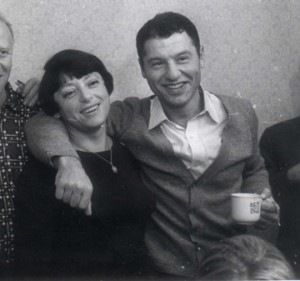 Nina Voronel is a very famous person both in Israel and in Russia – translator, poet, playwright, screenwriter, publicist, essayist, novelist. It is her translation of O. Wald’s “The Ballad of Reading Prison” that is considered classic. Among her works are 18 plays written in Russian and Hebrew, and half a dozen scripts in different languages, some of which have been staged in Israel and England. Her pen belongs to 3 novels that make up the trilogy “Gothic Novel” – “The Witch and the Parachutist”, “Flight of a Butterfly”, “Road to Sirius”, and novels “Tel Aviv Mysteries” and “Lolita’s Eyes”, as well as poetry collections “Raven-Voronel” and “Royal Affairs”. In the 60-70s, Nina Voronel, along with her husband Alexander, a famous physicist, actively participated in the dissident movement. In 1974, she immigrated to Israel, and in 2004 and 2006 she published two books of memoirs “Unvarnished” and “Sodom of those years”, in which she told about her meetings with K. Chukovsky, A. Sinyavsky, Y. Daniel, L. Brick, father and son Tarkovsky, David Samoilov and other, no less bright personalities. This memoir made a lot of noise and was received by the public very ambiguously. In February 2012, Nina Voronel turned 80 years old, but she still produces the famous magazine “22”, writes stories and essays. The reason for our acquaintance was her essay “Credit Club”, after reading which, I realized that I must definitely contact the author to ask a few questions. Nina was one of the rare interlocutors, communicating with whom, you do not notice the running of time. I offer readers our second conversation, which took place shortly after the end of Operation Pillar of Fire in November.
Nina, who do you think won this blitz war? Since the end of the Israeli-Palestinian conflict in November, there have been an incredible number of articles analyzing its outcome. The principle: two Jews, three opinions were no exception in this case.
You know, in Israel, we have this definition: Arab work. This is when you order a table and one leg is longer than the others and the table naturally swings. And what you're asking is what I call an Arab victory. This is a lost war, which the world calls a victory. The entire infrastructure of Hamas was razed to the ground, military supplies were destroyed, the sites from which rockets were fired, the tunnels through which weapons were transported, they themselves were driven into cellars, and after all this they declared victory.
And they released a perfume called the M75 in honor of those missiles.. The flavour of these missiles is as refreshing as the smell of Palestinian resistance missiles. The owner of a Palestinian cosmetics company said, Use victory as inspiration – It's so natural.».
If the smell of these perfumes fits the idea of an Arab victory, they are best sprayed in the toilets. Strange as it may sound, it seems to me that the international community, which so stubbornly supports the Palestinians, does not realize that even among themselves they cannot find common ground.
Meaning?
One Ramallah-based group, led by Abu Mazen, is continually at odds with another in Gaza, led by Hamas Prime Minister Ismail Haniyeh. Abu Mazen is a rather strange person, he does not give the impression of a strong and intelligent person, but apparently has some necessary qualities that allow him to be afloat. Someone says that his word means nothing, others believe that he knows how to get his way. And, indeed, he got the UN to recognize Palestine as an observer state. As for Hamas, they openly declare their goal to destroy Israel. They never recognize Israel’s right to exist and are constantly provoking us, as they have done this time. Interestingly, both of these leaders look, I would say, even too presentable, given the “oppression, suffering and poverty” of the peoples they represent, both are extremely concerned with their appearance and especially their hairstyles, both daily use the services of a hairdresser and a stylist. There is a fierce struggle between Abu Mazen and Haniyah. From time to time, Haniyeh's men arrest some people in Gaza, declare them Abu Mazen's spies, drive them in cages, beat them up on the way, cut them to pieces, and if these people are lucky enough to survive after all this, they are shot. Therefore, it is difficult to imagine that these two groups could agree with each other. In general, when we talk about the creation of a Palestinian state, we do not really know what exactly we are talking about. But paradoxically, public opinion does not dwell on this. No one cares that these are two different geographical areas, two autonomies that hate each other, and they are united in absentia without asking for consent.
Very often, the substance cementing friendship is a shared hatred of someone or something, in this case, Israel.
Of course. In this, the interests of the Palestinians and the “progressive” humanity converge. This time, international diplomacy immediately rushed to save Hamas from the “aggressors” – Israelis. Then Hillary Clinton and the new Egyptian president, Mohamed Morsi, joined in, and they managed to insist on the abolition of the ground opposition, and then Hamas declared victory, and all Western journalism supported them.
Speaking of journalism. In our first interview, you said that the Israeli press is mostly left-wing and, despite the obvious provocations coming from the Arab community, blames Israel for everything, that is, itself, its own country. Did anything change during the November War?
The Israeli press is largely liberal. As for Russian-language publications, they are mostly “right-wing”, but the Russian press is a ghost that no one hears or sees, except during the election campaigns. Only then do they remember us, or rather our voices. And in normal times, our media doesn't matter.
Nina, I'm going to ask a question that might sound naive, but I'm going to ask it anyway. It took eight long days to end this eight-day blitz war, and as rockets poured into Israeli cities, the country continued to supply Gaza with water and electricity. Largely due to this, all life support systems functioned there, night shelling did not stop, and the “message” in Khamastan clearly did not reach. Could you please explain why Israel has shown such strange condescension to provocateurs and terrorists?
Yes, we provide them not only with gas, water and electricity, but even yogurt. But the world, which is already against us, is just waiting to accuse us of another sin. And if we turn off the vital systems of providing for civilians who start running in front of cameras with children in their arms, it will be regarded as the worst crime since Jesus Christ. Honestly, I would personally turn it off, but the government had its own reasons not to do so, and it does not share its views with me. I cannot accuse the people who lead our government of being weak or short-sighted. So they have more reasonable ideas about it than I and many others.
Why should anyone be allowed to interfere in Israel’s internal affairs? Here's a fresh example. Agree, it would be absurd that England dictated to Russia or the United Arab Emirates where to build high-rise buildings and where to plant gardens. But recently, the Foreign Ministry of several European countries, including Britain, Sweden, France and Denmark, summoned Israeli ambassadors and “advised” to influence the government’s decision to build 3,000 apartments in the East Jerusalem area. Otherwise, these countries threatened to withdraw their ambassadors and expel Israelis. How can we explain such obsessive attention and impudence toward Israel?
I have asked myself and my friends this question many times and I have no answer. I suspect the world has long been ruled by Arabs.
Many people believe that they are Jews.
I mean, the whole world is trying to please the Arabs, and it's usually catering to those on whom they depend. Isn't it? I don’t know how long ago it became the norm to ask Israel to report, and in that sense we are the only country that has to ask for permission on any issue. It seems that everyone is aware of what terrible events are happening in the world, including genocide, persecution for religious affiliation or political views, etc. It is reported, but nothing more. But if ours A Palestinian who tried to blow something up was killed on the border, and it immediately appears on the front pages of all Western newspapers. Just a month ago, the Turkish army (tanks and aircraft) invaded northern Iraq and conducted a military operation in which at least a hundred Kurds were killed. But no one blamed Turkey for the aggression, demanded an explanation or condemned it for using excessive force. And we have a duty to report and ask for permission on everything that happens even within our borders. Is it because we are the chosen people? It is not clear why humanity is so unfair to us.
Yeah, there's some bias, there.
Prejudice... Have you ever been to Berlin? There is a wonderful Jewish Museum, designed by former Israeli architect Daniel Libeskind.
The one that won the competition to renovate Ground Zero in New York.
Yeah. It should be noted that the Jewish Museum today is one of the most visited, there is always a turn. Now, as you go from hall to hall, you are essentially reading the same story: a duke lived in this city, breaking from bread to kvass, and then a cunning Jew appeared and taught him to mine silver or make wine, and when the duke became incredibly rich, he executed this Jew. Stories like this are repeated endlessly, and it's so depressing that I couldn't finish the exhibition. For, say, 400 years, from county to county, from principality to principality, the same thing happened everywhere, as if in ridicule.
- It turns out that history teaches us nothing; ambitious Jews do not understand that they should stay away from power.
I guess so. But you have to live, and if you do not stay closer to power, there is only one way out - to the next world. But we've outlived all the enemies so far, and hopefully we'll outlive those.
I assume you follow the news every day. Here, for example, just yesterday passed the story: in order not to offend the feelings of Muslims, Brussels decided to abolish the Christmas tree, and on the main square installed some inappropriate design of plates. It seems that this does not concern us, unless, of course, we delve into the essence. Tell me, how do you react to the latest news that shows that political correctness continues to achieve the remnants of common sense? Is it worth taking to heart the absurdity of what is happening around us? Maybe you should take the advice of those who say, “Life is too short to waste your health on something you can’t change.”
Even if they decide not to risk their health, it will deteriorate for another reason. If the people who abolished the tree come to power, it will inevitably affect those who care so much about their momentary peace. Do not think that the consequences of indifference will somehow miraculously bypass them. Honestly, when I heard about this tree on the news, I felt sick, even though, as you can see, I don't celebrate Christmas. Agree, when a country voluntarily humiliates itself, spits on its own traditions for the sake of those who came to a prosperous, hospitable home, and then begins to unceremoniously install its pods there, strongly resembles masochism. But for some reason, no one wants to upset these nervous, unpredictable guests, and no one cares if you, me, or the citizens of Brussels are upset about something.
Because you, me, or the citizens of Brussels will not blow up school buses out of frustration.
Yes, the world is intimidated. The United Nations voted for Palestine, which was granted observer rights. Are all the 138 countries that voted against Israel and America so ignorant of the truth and hate Israel? Hardly. But I may well assume that some of those on whom the vote depends have received personal threats involving their families. If, of the 188 countries that voted, 138 voted against the United States, why does your country continue to support this organization?
Are you asking me? Well, probably for the same reasons you keep supplying Hamas with yogurt.
Not so long ago, I interviewed Lia Akhedzhakova, and she admitted that she was afraid to live. If you retrospectively go through the stages of your life, which one is remembered as joyful, and which one would like to forget?
I always recollect my childhood with hostility, or rather, I hate it. The war and everything connected with it still haunts me. The second monstrous streak is the time before leaving for Israel. When my husband, Ph.D., applied to leave, the KGB surrounded us with very close care. As soon as we left the entrance or walked down the street, a car with gabists followed us at the pace of steps. Sometimes they approached and, not shy, threatened, intimidated. It's not easy to survive. When we left, all the departing people went up to such a gallery and waved to the escorts from there. And we were led to the landing through some basement. And we've been driving for so long, I wonder if we're going somewhere where we don't need tickets anymore. And most importantly, everyone will think we're gone and we're going to jail or God knows where. I'm not a hero at all and I'm not ready for feats. I will never forget those stone faces.
You say that you are not a hero, and I know that opposition to power always requires the presence of courage and fortitude, especially when a person does it consciously, understanding the possible consequences. You and your comrades-in-arms, Sinyavsky, Daniel, Sarnovy, Voinovich – just referred to such “non-heroes”. By the way, last summer I read Vladimir Voinovich’s book “Self-Portrait” and, to my surprise, did not see your name on any of the 900 pages. Is there any way he can forgive you for criticizing him about Solzhenitsyn?
Apparently he can't. When he published a book about Solzhenitsyn, we said in an interview here that we were ashamed to read it, that we should not have written it like that. I was especially offended by Voinovich’s phrase about the Gulag Archipelago: “You think I knew this for a long time.” Maybe he did, but he didn't. And Solzhenitsyn wrote. And this “small” difference puts a fence between them, which Voinovich will never climb. But I didn't want to offend him or Ben Sarnov, who quarreled with us by supporting Voinovich.
How do you view your dissident past over the years?
You mean, was it worth it? Of course I should. This is not because the dissident movement, as many believe, has changed the face of the country. It's just part of my personal life, my growing up, my understanding of people, it's part of the big events of that time. There are people who shout at every intersection how ashamed they are of living under Soviet rule. Maybe so. And I am absolutely not ashamed, because I never sinned against myself or against my convictions, I did not play along with anyone. Yes, I was not put in prison like Larisa Bogoraz, but in my “coordinates” I did what I could.
Do you regret that your dissidence has hindered your brilliant literary career?
You are right, there were real losses, although it is not known whether everything would have turned out as it had been dreamed had I stayed in Russia. There were some sobering moments. Remember the famous composer Michael (Moses) Weinberg, the first husband of Natasha Mikhoels? He was almost a deity then.
He became known to the general public after the release of the film “Cranes Fly” with his music.
I personally did not know him, but he caught the eye of my play, from which he wanted to make a play or, as they now say, a musical. If that happened, his fame would have touched my career. But Natasha, with whom he was already divorced, but still visited her, said: “Are you crazy?” Crowonel was sent to the exit, and it was all over. There was another story when Obraztsov wanted to stage my play, but also did not grow together.
Weinberg was arrested, and after Stalin's death he was rehabilitated at Shostakovich's request. Why would he risk his career over a musical? It can be understood, like many others.
Sure. But you asked about the losses. I don’t know what I’ve lost, but I know I’ve gained a lot. When I arrived here, I read mostly English literature, and as a result, I realized that the Russian, with all its designs and equivocals, was wrong. Today it is said that the Russian novel is dead. No, we just have to learn how to write it.
Is it interesting to write without replacing meaning with word play?
Exactly. What I write is completely different from contemporary Russian literature. But coming back to the issue of loss, I have to say that I was lucky to see the world. I have lived many times in America, England and Germany. I saw everything with my own eyes and realized that there is another world, another space. After leaving the USSR, I got a second life, which, in many ways, was more interesting and richer than the first.
As far as I know, you were working on another book this summer.
Yeah, but not just in the summer, I'm still working on it. Last winter, I started writing the novel The Secret of Sabine Spielrein. Today he's almost ready, left to put the farewell touches. The topic itself fascinated me so much that I constantly – while eating, walking, some household chores, and even in a dream – replayed the scenes, dialogues of this book.
What's the subject?
Sabina is a real character, an unusually talented woman who was born in Russia, and at the beginning of the century left for Switzerland, made a brilliant career in psychoanalysis, became a friend of Jung and Freud’s attorney, after the Revolution returned to the USSR and then shot by the Nazis near Rostov. I was literally shocked by her biography and it’s not that Sabine was an outstanding woman, that she had relationships with great people, but that her biography is the imprint of history, and, moreover, one of the most tragic periods of her life. The horror of her fate lies in the fact that, having achieved recognition in Evprop in 1923, she returned to Russia, to Moscow, to develop psychoanalysis and create a “new man.” And then psychoanalysis was banned, and everyone associated with Trotsky disappeared from the world. Sabina was forced to hide, and in 1942, after the capture of Rostov by the Germans, she tragically died along with the rest of the Jews shot in Zmievskaya Balka.
I honestly haven't heard of this place.
Yes, everyone knows about Babi Yar, and the information about Zmievskaya Balka is somehow silenced. Within a few days, 23,000 Jews were killed. The fact is that Rostov was the conditional key to the Caucasus, and since the Soviet authorities assured that this city would never be surrendered, a huge number of refugees accumulated there. It is no longer possible to surprise anyone with stories about the atrocities of the Nazis, but in the process of preparing for writing the novel, I discovered a strange thing: immediately after the capture of the city (for example, Melitopol or Taganrog), without even having time to quarter or unpack their suitcases, the Germans first made lists of Jews and dealt with them in the shortest possible time. Moreover, this was done by the same team, moving from one place to another and proceeding to exterminate the Jews with such zeal that it seemed that this was the main military objective of the attack on the Soviet Union. It was like insanity, like general madness.
What do you think can explain this?
It is clear that they acted according to command orders. Did you know that there is a famous speech by Himmler in which he said that every general must kill at least 100,000 Jews and promised that mankind would be grateful for it?
Just recently in Boston publishing house M-Graphics published your book with a promising title “Black magician”.
You know that my main principle: you can write as you like, as long as you do not get bored. I once wrote several adventurous thrillers about the adventures of an Israeli paratrooper in Europe, and this book was very successful. But some critic reproached me for ignoring the topic of Russian-speaking immigrants in Israel, that is, not writing about us. And I didn't feel "us" at the time because "us" hadn't yet formed. But the moment came when I realized who we were, a Russian group of former Soviet Jews who had acquired their shape, their representatives, their mentality projected on the local conditions and traditions. That's when I decided to write about us. The novel consists of four parts or stories, united by the same characters who find themselves in acute situations. The whole story is about the Russian presence in Israel and our understanding of this reality.
As in all of your books, are these characters also the “wirls of space”?
Yeah, that's why extraordinary things happen around them. And, to my own surprise, these characters find a solution through the most insignificant character - the husband of the main character, who can not adapt to the life here, but knows the main principle of Nabokov: the main thing is literature, and life is its repetition. And every part of the novel confirms that the solution to problems grows out of the literature written by this hapless hero.
Is he the Black Magician?
Yeah. What he writes comes true.
Nabokov you probably remembered for a reason.
The last part of my book is called “The Eyes of Lolita” and essentially repeats the plot of Nabokov’s novel, but through the eyes of a girl, the daughter of the main character.
Are filmmakers interested in your novel?
Alas, I was late because Humbert is a pedophile in love with a girl. And now this is categorically not allowed on the screens. Today, in Prince, a film about Lolita would have been impossible.
In addition to writing, you are engaged in publishing – together with your husband, you publish a very famous magazine in literary circles “22”. What criteria do you adhere to when selecting material?
- These criteria are not simply formulated in one sentence. Of course, first of all, it is the quality of the text and its relevance in the modern world. The fact that we are Jews makes us particularly sensitive to Jewish fate around the world, and Israeli citizenship outlines a range of political issues that particularly affect us. Our Russian upbringing has also instilled in us a literary taste, which we try to preserve despite the cacophony that now reigns everywhere, including in Russia.
And why does the prose of Dina Rubina, perhaps the most famous Russian-speaking author of Israel, not appear on the pages of the magazine you publish?
We typed Dean Rubin until she got into a fight over some critical article about her in our magazine. She shouted into the phone in the loud voice of a bazaar trader: “I can’t stand being criticized!”
What kind of people made an unforgettable impression on you?
I was lucky to meet many interesting and outstanding people in my long life, it is even difficult to list them. But I cannot call any of these meetings, even with the family of A.D. Sakharov, the most memorable and important in my life. The only meeting I can name is a meeting with my husband, Alexander Voronel, in my opinion, one of the most outstanding thinkers of our time.
Thank you, Nina. Good luck to you.
Nina Voronel’s novel “Black Magician” can be ordered on the website of the publishing house “M-Graphics Publishing”
Interviewed by Zoe Master