April 4, 2013
Under a Lucky Star
This story was originally written in Russian. This is an AI-generated English translation.
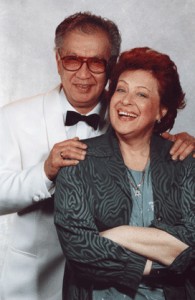 In the 60-70s, no big concert was complete without the duo Alla Ioshpe – Stakhan Rakhimov. They met in 1960, in the final of the amateur contest, where they shared the first prize. Since 1962, joint performances of singers on the professional stage began, where they were invariably successful. In 1979, due to the need to treat Alla Ioshpe in Israel, the artists began to conflict with the authorities and until 1985, their voices almost ceased to sound on the air and on official stages. As it often happened in Soviet times, the favorites of the public became the enemies of the people. They were stripped of their titles, all their television recordings were demagnetized, all their records and tapes disappeared from sale. Ioshpe and Rakhimov were constantly summoned to Lubyanka and practically kept under house arrest, while spreading rumors that they had long lived in Israel. Everything was done to destroy the very memory of the existence of these artists. It was only in the late 80s that Ioshpa and Rakhimov were allowed to return to the stage; first they sang in the district centers, then in the capital halls. Recently, this creative and family duo celebrated their 50th anniversary.
Under the lucky star
Interview with People's Artists of Russia
Alla Joshpe and Stakhan Rakhimov
- Alla Yakovlevna, preparing for the interview, I c I was surprised to find that the title of People's Artists was awarded to you only in Russia. In Uzbekistan, you are deserved. Is that really true?
- Yeah, that's true. But we didn’t live in Uzbekistan, all our creative activity is connected with Moscow. So to be the Honored Artist of Uzbekistan is a great honor.
- Do you owe someone your success? Did anyone help at the beginning of his career with advice, mentoring, patronage?
- No, we helped each other. Success came to me after The Unlaughing Princess, and to Stakhan after The Arabian Tango before we were a duet.
- And now that you are masters of the Soviet stage, does anyone come to you for help or advice?
- Of course, we are very pleased that many artists care about our opinion, that our advice is listened to. In general, we like the word masters much more than legends. Legends are something ancient, invented. As for helping young artists, we provide them with the opportunity to take the big stage in our annual holiday programs “Alla Ioshpe and Stakhan Rakhimov Invite”. Recognized masters also participate in these concerts: Joseph Kobzon, Tamara Gverdtsiteli, and very young guys unknown to the general public. For the past four years, this is how we celebrate Hanukkah. I don't want to sound immodest, but these meetings take place with a full house.
- Which one of your wards has high hopes?
- Well, for example, Alena Firger, who is already singing in leading musicals.
- Have you ever encountered the ingratitude of your students?
- Fortunately, no. And you know why? Because we don't expect gratitude. I don’t think anyone owes us anything. We do good for ourselves.
- I understand. But, unfortunately, it happens that sincere, selfless help is not valued and not remembered. I am sure that Muslim Magomayev also did not expect gratitude from Nikolai Baskov, having listened to him at home when he was an unknown vocalist. And now, becoming a star, Baskov allowed himself a tactless joke in the address of a really great singer, especially recently departed. Not only did he not seem to recognize Magomayev's voice in the recording, but he also called the performance talentless. This video on the Internet was watched by thousands of viewers. Of course, you should not wait for gratitude, but it is not for nothing that ingratitude is considered the worst of vices. And when some of the artists who believe in their greatness are blown away by success, money and screaming girls, they forget about it.
- See how it happens... And at one of the big concerts, Kolya Baskov so respectfully announced our number, said such beautiful words in our honor.
- Maybe he was announcing the script. Who knows?
You have often performed with Magomayev in national concerts. How do you remember him?
- Oh, that was unique in its own way.at talent and level of intelligence artist. First, he was an unusually decent man. Not like the current “stars”, never took money for a performance in advance. Yeah, we were close friends. On one of our tours, it coincided that Magomayev’s concert was to take place in the same hall as ours, but a day later. We asked the impresario to change our tickets in order to listen to Muslim, and to come unexpectedly for him, because it is so nice to have friends hand you flowers away from home. And you know, we were just amazed at how Muslim behaved, how he introduced us, how the audience applauded. You see, it was not just a gesture, but a high act. And so he was in everything - noble, sincere.
- I want to ask you about another untimely departed artist - Valeria Obodzinsky. I read that you were the one who organized the first concert in his memory. Is that so? Did you have a special relationship with him?
- Yes, it happened at the time when Stakhan worked as director and artistic director of the “Estrada” of the Mosconcert. So let him talk about it himself.
Stakhan Rahimov - Valera and I worked together, toured, we had one producer. Therefore, we communicated with him quite closely, and when he died, we organized the first concert dedicated to his memory, which was attended by a huge number of artists performing songs from his repertoire.
- I think this is a very difficult task, given the unique timbre of his voice.
- Yes, I was distributing the repertoire, and it turned out that there were no artists for the songs “These Eyes Against” and “Angela”. Then, just a few days before the concert, Alla and I had to record “These Eyes Opposite”, and I sang “Angela”. These songs are still in our repertoire.
- How to explain the short-lived fate of this unique artist?
- You know, the Soviet Union is a rather complicated country, where the fate of artists depended on the will of one or two people. On television, everything was run by the all-Union famous Lapin, who treated the Nazis, and especially the Jews, quite negatively. Among the rejected was Valera Obodzinsky, and me and Alla, and Vadik Mulerman, and others. But since the country was international, there were official representatives of one or another nationality: official Jew – Kobzon, Tatar – Renat Ibragimov, Azerbaijani – Muslim Magomayev, Belarusian – Viktor Vuyachic, Uzbek – Batyr Zakirov, and so on. The rest of them were not allowed there. But now the situation is even more complicated. But then everything depended on the will and desire of the Chairman of the State Committee of Radio and Television, which had a blacklist.
- But I remember very well that Mulerman appeared on many TV shows.
- First appeared, though infrequently, then less often, until he disappeared. Certain artists were not allowed to be widely promoted, and if an artist is not occupied, that is the worst thing that can be. You see, artists are the same people, with their weaknesses, touchiness, and not all are different willpower, strong nerves. Alla and I were lucky, the two of us. And Valera broke down, and alcohol broke, and that's what happened. Valera sang amazingly, he was fantastically in demand by the audience, and at the same time had no official recognition. Hence the long, deep depression.
- Why did you say the situation is even more complicated?
- Because today, it is very difficult for young artists to be noticed and then break through to the top. Television and radio are blocked by certain groups – Pugacheva’s team, Krutoy’s team, Matvienko, and rarely anyone they let in. There is a staffed set of vocalists, composers who spin on the same channels, in the same programs, and beginners get there with great difficulty. And even the wonderful program "Voice", which revealed beautiful, talented guys who could safely participate in all concerts, not inferior to famous artists, will help to "unwind" only one or two. You know what I mean?
- Not exactly. First of all, I think the goal of any producer is to discover new talent and capitalize on it. Second, there is a better chance of breaking through when there are options than in the days of Almighty Lapin, when there were no options.
– Maybe you're right.
- Do you watch TV often?
Stakhan Rakhimov: - I can't watch TV, especially concert programs, because it reminds me of a dress-up show. The same artists sing songs, then parody each other, and pretty quickly this carnival gets boring. The only decent, in terms of quality programs, is the channel "Culture".
Alla Joshpe - Yeah, there's a lot of channels, but Stahan's right, you rarely see a new star. Basically, it is 10-20 artists participating in all concerts, shows, competitions.
- Who would you like to see more often on Channel One?
- Like Diana Arbenina. After all, she is an amazing, unique singer, and began appearing in major concerts only a year ago.
- Since we are talking about the stage, tell us what, in your opinion, has changed for the better in this difficult “light” genre?
- It’s hard for me to judge, because Stakhan and I found our niche from the very beginning, and there was no one to compete with. And if we talk about duets, then singing together does not mean singing as a duet. You know, when we were still in denial, but the order was given to let us on stage, we had an audition.
- Have you lost your form in 8 years of silence?
- I guess so. When we sang, someone on the commission said, "You don't sing together." And I said to him, "Put Rakhimov and I in different parts of the world, and we will take our breath together." You see, a duet is one philosophy, one instinct, one breath.
- It always seemed to me that your singing style was very much in line with Tariverdiev’s. Did he offer you his songs?
- When I was a girl and lived with my parents and sister, Mikael Leonovich came to our tiny apartment on Malaya Bronnaya and said that he had songs for me. He began to work with me, taught me how to sing his songs, which were very difficult, I must say. But I was happy with the mere consciousness of being able to learn from him. We ended up doing a 40-minute show where I sang with him. For me, a 19-year-old, it was a serious school, and of course, the meeting with Tariverdiev, with his music, remained in me for life.
- How comfortable do you feel on the modern stage, which is not stage, but show business?
- We have lost so much time in our creative destiny that we try to make up for it and therefore perform a lot. Last year was an anniversary: 50 years on stage and in life. Our concert took place in the Estrada Theatre, which was held with such a sold-out that even close people had nowhere to sit. As it turned out, they even sold double tickets. Opening the concert, Gena Khazanov said that when there are not enough seats, it is the biggest gift for the theater and the artist. That day we heard so many nice words from our guest artists that it's embarrassing to repeat them.
- Speaking about your “colleagues in the workshop”, in one of the interviews Alla Pugacheva joked unsuccessfully, saying that she changes husbands so that she is not forgotten, like Ioshpe and Rakhimova. There's some truth in every joke. So maybe the number of publications in the yellow press and appearances on all sorts of talk shows is an indicator of stardom?
- First of all, she wasn't kidding. And secondly, I'm going to make a joke: we were in the yellow press, too. Imagine, after numerous anniversary programs, including “While all at home”, we were shown a magazine (either “All stars”, or whatever it was called), where on the cover of two photos and the headline: “Alla Joshpe left her husband ...”. We open, and there is a continuation of the phrase ... for the sake of Stakhan Rakhimov, and then a large article about us.
- Well, yes, such an attractive strawberry, and an abandoned husband is actually your first husband, Alan Chumak's brother.
- That's right.
- Does the water that is charged with it actually have healing properties?
- I think water helps those who believe it. Medication will not help if there is no faith.
- Do you have a talisman?
- Yes, the pendant, the pendant of the Star of David is my amulet. I was convinced of this when I was in a serious accident in Cyprus. I forgot to wear it that day. Besides, we didn't get health insurance at the time; we thought, well, what could happen in four days?
- And you think the pendant would have prevented what happened?
- Who knows? But maybe the minute I would spend putting on a chain would allow machines to pass through time and space.
- Let's go back. As a child, you loved reading so much that you even set up a library for your classmates. Tell me, this passion for reading did not lead to the formation of a book perception of life?
- Yeah, I've always loved reading. From every business trip, my dad would bring books, and when we opened the box, my heart literally fluttered with the smell of fresh printing paint, with anticipation of the moment when I would be alone with the book. As a child, I was often sick, lying down, bored, and books filled that time with meaning. But I didn't grow up as a book girl in the sense that I walked away from reality. Quite the opposite: I developed a rather strong character, which manifested itself during my admission to the institute.
- Yes, you entered MSU in the psychology faculty. Do you know what your classmate, now Doctor of Psychology, Lyudmila Obukhova, wrote about you?
- Lucia? No, I don't know. Why?
- She wrote the following: “But the brilliant Alla Ioshpa at the entrance exams had a hard time: and the origin is not the same, and the nationality is not the same.”
- Yeah, she's right.
- What exactly did she mean?
- It's very simple: I scored 19 points, getting all fives and one four. The passing ball was 18, but I was not on the admission list. When I didn’t see my name, I thought I was going to die. So I went to the rector.
- Did he explain these miracles of mathematics?
- He didn't explain anything. He said that he did not pass the competition and offered to pass the exams for philology. Without any opportunity to prepare, I was sent to exams. I got one four again, in Russian oral.
And I was told to take the papers. I said, never in my life, I will learn.
And then they made an extra place, and I entered the psychology department, successfully graduated from it, then defended my thesis, became a candidate of psychological sciences.
- By association with what you have said, I will cite a line from a recent interview with the recently deceased Oscar Feltsman: “... the Jewish question never touched me...” You know, I have no reason not to trust Oscar Borisovich, but with all due respect to him, as one of the heroes of the famous film said, I am tormented by vague doubts.
- There's nothing strange about his words. The fact is that Feltsman's songs were accepted anyway. In addition, it coincided that most of the Soviet songwriters were Jews: Fradkin, Kolmanovsky, Frenkel, Schwartz, Ostrovsky... If you pushed one, you had to push everyone. Who's going to write songs then?
- Makes sense. You often communicated with Oscar Borisovich, performed his songs. Tell me what he was like outside of official meetings with journalists.
- Amazing, touching, funny. You tell him, "Oskar Borisovich, that's a good song." He replies, “No, wonderful,” and everyone laughs at his habit of agreeing to begin every sentence with the word. no. He wrote a lot of wonderful songs for us, and in general it was a joy to communicate and work with such a talented person.
- In many interviews, you talk about eight years of forced downtime when you were barred from speaking in response to an application to leave for Israel. There is a theory according to which difficulties temper the will, and luck - it relaxes. As a student of creative philosophy, do you agree with this view?
- No, overcoming injustice, stupidity or preconceived prejudice is not necessary. You can do without all this. On the contrary, all this forced struggle for existence often breaks people, and at best, takes years of creative life. In general, a person tends to survive as long as he can. We are often asked how we survived this. In one of my books, I answer this question: Who told you we were? survived?».
- In the same "non-visiting" years, you organized at home the home theater "Music". in Refuge» – (music in denial - Z.M. They were like you, and they were like you. Who were these people, and who do you still have a relationship with?
- We did not initiate communication because it was dangerous to communicate with us. That was the time. In '79 Stakhan put down his party ticket and declared us enemies of the country and the party. Yes, the same refuseniks came to us – Savely Kramarov, Vladimir Feltsman, Nathan Sharansky. We helped them a lot, then we saw them off. But they left and we stayed.
- You wanted to leave because you were sick, because you needed surgery.
- I have had problems with my leg since childhood. Operations in the Soviet Union did not help. We needed an operation abroad, and we applied for travel to Israel. And what is especially mean, while we were sitting in Moscow, selling everything that was in the apartment, rumors were spread about us that we were poor in Israel, that Stakhan was selling domestic pilaf there. We slept on the bookshelves, there was nothing left in the apartment. Yes, it was difficult in all respects, but I think my daughter suffered the most. She was a freshman, an excellent student. She was expelled from Komsomol, from MSU.
- Why didn’t you leave when it was possible?
- It was late, time wasted. And when we could leave, we started to come alive. Our first trip after almost 10 years of silence was to America. There are no words to describe how we were received. Since then, we have traveled to America 17 times. We were invited several times a year, so we were able to get back on our feet.
- At the beginning of our conversation, you said that the title of Honored Artists of Uzbekistan is an honor for you. But you have hardly forgotten how Rashidov, the first secretary of the Communist Party of Uzbekistan, when he heard about your decision to leave for Israel, said in a rage.: Rakhimov! I would rather go to the Far East than the Near East. Perhaps you have forgiven everything to those who deprived you of the stage and means of subsistence, if you did not leave in the late eighties..
- You know, the people who stole our lives didn't ask for forgiveness. But on our anniversary, Dmitry Medvedev sent a congratulatory telegram. He wrote that many good people grew up on our songs “Alyosha”, “Goodbye, boys”, that Stakhan and I did not get angry, did not become hardened, despite many years of unjust forgetting. You know, I think that Dmitry Anatolyevich’s ability to sympathize with people, his attentiveness, comes from Sobchak, who was his scientific supervisor of his PhD thesis. At our concerts in St. Petersburg, during the performance of the Prayer (Psalm) to the poems of King David, Anatoly Alexandrovich rose in his bed and listened standing.
And we remember that.
- Tell me, do you know how to philosophically, turning off emotions, approach problems, troubles, resentments, conflicts? In fact, can you learn how to do that?
- No, you can't learn it, it's a life position.
- One of your four books is called In the City of the White Crow. The white crow seems to feel different from everyone else. Am I right?
- We were the white crows.
- Were they or did they feel they were?
- You’re right, that’s the feeling of people like us.
- What kind?
- People who just wanted to live, and they were not allowed to fly, too. But now I think it's a good thing we didn't leave. But it came with a lot of blood.
- Are you and Stakhan Mamjanovich religious people?
- We don't go to pray. But there is a G-d for us, of course. Stakhan says he was born under a lucky star. I'm glad that after 50 years of living together, my husband says so.
- Tell us about how you spend your time. Where are you going? Where and with whom do you prefer to spend time?
- We drive a lot. We often visit Cyprus and Europe. I spend a lot of time at the computer. Stakhan is a uniquely gifted person, he likes to make everything with his own hands - from furniture to some crafts. Of course, we go to the theater, to friends. But post-concert feasts - not for us: sang a few songs - and left. We're so used to living.
- You said you often come to America despite long-distance flights.
- Yes, I already said that Stakhan and I owe a lot to this country The American Russian-speaking viewer supported us at a very difficult time. America accepted us when we were not allowed on the big stage in Russia, and thanks to this, we gained a second wind and self-confidence. We will always be grateful to this country.
- What about the fake American smiles?
- These are the smiles of well-mannered people. I wish people would smile at each other more often, for no reason. It won't get any worse. Do you agree with me?
- I'll take your word for it. Good luck to you and your health.
- Thank you.
Zoe Master was talking.
Official website: www.zoyamaster.com