May 1, 2013
I Will Cross-Stitch a Star of David for You
This story was originally written in Russian. This is an AI-generated English translation.
George Frumker is a man who speaks with aphorisms. And our own. He describes himself as a figure-word master, and anyone who doubts this can read one or all of his five books, as well as a look at Anthology of Twentieth Century Satire and Humor, which features some of his parodies and epigrams. Here is what George Frumker writes about himself:
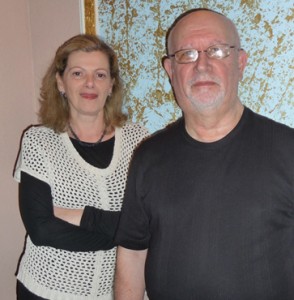 “I love humor, a good joke, even if it is directed against me. I'm joking in totally unfunny situations. A friend of mine, who almost fell into a cemetery hole from some joke I made, said she wouldn't take me to the funeral again. But I am, alas. Only a hole like the one my friend almost fell into can fix me. ?
However, George Frumker decided to publish his first book only after he was inspired by poems from the book of the New York poet: “I threw my heart in front of you on the road and suddenly felt your two legs on it.”
Since then, to the delight of fans of a good joke, he has not stopped. Maybe because the material for parodies does not run out, as well as the number of candidates for epigrams, or maybe because humor is something that prolongs the life of both the author and his readers.
"I'll make a cross for you to make a modendove."
Interview with George Frumker
Georgy, at what age did you realize that you can earn money from the ability to laugh and entertain?
- That this "skill" can earn, I realized when eighteen years old received the first fee from the "Lit. newspaper". However, the amount was so insignificant that it itself was like a joke Earnings and it was impossible to call it. At the same age I had the opportunity to confer in the province near Kiev. This was the first full-fledged earnings. There, for the first time, joked from the stage (although the legs were trembling).
I guess you were very popular with your classmates in high school.
– As for my popularity, among my classmates and teachers, I was considered a fantastic lazy person. But there was no meeting without me. I joked about everything and everyone, but then it was harmless. With age, the character seems to have deteriorated.
- Tell me about yourself. Who were your parents?
I can talk about my parents for a long time. Both have unfinished higher education, the war prevented. Musical hearing, or rather the complete absence of it, I inherited from my father and grandfather on the maternal side. Unlike me, they didn’t like to sing. I loved it since I was a child, and at school, the singing teacher begged me to be quiet in exchange for a four on her subject. My voice, as you can see in the speech, is powerful – I managed to knock down the whole class. My father had an amazing sense of humor. From my mother I inherited a hypertrophied love of reading. It's hard to talk about my education. There were 4 schools fighting for me, each one knocking me off. Lost the evening, where I went to the last class. Then - a technical school, a theater studio, an institute, a drawing school at the House of Architects, an invitation to the team of handball players (goalkeeper). I didn't bring any of the above to mind.
- It would seem that there is a successful career ahead, but you decided to go on free bread, and in 1979 you went to the United States. And this despite the fact that your ironic poems were printed by Literaturka, the most prestigious newspaper of the Soviet Union, and here, as far as I understand, nothing of this was promised to you.
- As for the reason for leaving, there are actually several.
I joked constantly, knew a lot of jokes and invented them myself. For chatter, I was once called “where to go” and quite intelligently, but strictly warned. I've been quiet for a while. But to overcome myself was difficult, my jokes were enough, although without my name. “Partorg is a seller of air,” “Liquid is a dystrophic Jew.” There were also poems – “Letter of Boris Butkeev from Krasnodar” – following the tracks of Vysotsky’s song. Now few people remember them, and in those distant years in Kiev it went hand in hand. In addition, what I wrote began to be blatantly stolen and published under false names. The last straw was a large collection in a fairly large magazine of my things, signed by an unknown person.
I was already married by then. So I decided to get away from sin... I can say that “free writer’s bread” is often not very free. Life in emigration was quite difficult in the beginning, but who was it easy? My first publication in America was in The New Russian Word.
- Your good friend and colleague Vladimir Vishnevsky once said: “We are public people and go on stage to like.” Do you also think that the desire to like is the meaning of your profession?
– There is such a small nuance as the magic of the scene. When you get there, you get a lot of fun. And when you feel the "giving of the hall" ... Of course, I want to like the audience. To flicker on the stage for five or seven minutes in a national concert and like – a lot of talent is not necessary. Here to keep the auditorium during a solo two-hour performance, and so that “mocked” in the lobby – this is the meaning, and the reason, and the real professionalism of the “talker”.
- Half an hour ago you said you divided people into smart people and fools. Who have you met more in your life, first or second?
- If I were to divide only into wise and fools... “There are actually more intelligent than stupid people. It’s just that they’re much less common, sorry to quote myself.
Bulat Shalvovich had it: "... for every wise man a fool." Everything is equal, everything is fair.” I said a little bit:
But it seems to me that at the turn of the century
We need to rethink this.
There is a clear progress of fools.
There are ten of them on the smart one today.
- What are the criteria (or symptoms) needed to diagnose a person—sorry, are you a fool?
- You're forcing me to improvise... A fool is a man with whom he does not want to talk even about himself. Moreover, you literally forced me to compose quatrains, which I am even happy about. Now...
A fool always thinks he is a genius.
A fool is always drunk,
A fool knows nothing of doubt,
Because he knows he's smart!
- Great! I'm glad to be your muse for a few minutes. And how do your epigrams and parodies reach those to whom they are intended? And in general, when you write an epigram, say, on Pugachev, do you do it for the public (readers), or do you set a specific goal to convey your opinion to the artist to whom this epigram is addressed?
- When I write an epigram, I do not think at all about how widely it will spread.
As for the fact that my epigrams reach, there is no doubt. My books have been printed by the tens of thousands, it just doesn’t happen. It’s funny to think that I can make a difference in show business or politics. It’s like burning porridge to fill with milk and sugar, but it will not taste better. Although, if you remove the porridge itself...
In addition to epigrams for specific people, I have a whole cycle of so-called “momentary epigram reactions” to an event. Once in Russia, news was very popular “in the morning in the newspaper – in the evening in the verse”. I have epigrams for the loss of the Russian football team, for the entry into Russia of the “new law on benefits...”
- During your speech, you said that you write mostly good parodies. What about the epigrams? Here are some:
“Do not let G-d with Alsa’s voice call for help in the wilderness.”
To Alla Pugacheva:
" I personally think one thing: there is no chance of catching up with you. And your train left a long time ago... Back in the stagecoach era.
or Rosenbam.
" Of course, there's something you sing. But the approach to poetry is inaccurate: You do not succeed in poetry without music. And perhaps not so much with music.”
Here Ilya Reznik is not jokingly offended at you and even threatened at the meeting “to beat the face”. You know, I read somewhere that a poisonous word can close the chakra of creativity. Have you ever had any fears or remorse that artists, who are naturally sensitive people, would be offended by the kind lines dedicated to them?
– Of course, I've said that parodies are good. If the epirgamma can still be good-natured (although it seems that they should not), then parody a priori is not. This is the basis of the text - on an unsuccessful thought, clumsy style, violations of the system, etc. If my word could close the creative chakra of mediocrity, I would be glad. Unfortunately, there is no creativity or chakra. According to Ilf and Petrov, “there are Jews, but there is no Jewish question.”
In venerable poets, I often catch and play ambiguity in verse. If someone is offended, it is more relevant to your question about fools and how to distinguish them. Alas, graphomaniacs won't die. If someone wants to get even with me... To Reznik, for example, I replied:
And in the world of old or new,
This goes on for centuries:
Poets kill with words,
And graphomaniacs with fists.
I could have answered, but
I'm not interested in this argument.
Because it's confusing, poor man,
Poetry and lyrics.
- Did someone write epigrams on you?
Two epigrams were written on me. One, alas, very incompetent, and the same Reznik.
At the same time, it turned out that he wrote the same epigram to several people, just changing the object. One good (response) entered the book of Valentin Gaft. There was also a very weak parody about which there is no point in even talking. Anyway, that's what I know.
There's one really brilliantly mocking parody of me, it was written by Naum Sagalovsky. He even called me and asked if he would be offended if he printed it. I said I would just laugh with the readers.
- They say that in ordinary life, professional humorists are quite frowny people. You have met and communicated closely with many artists known for their sense of humor, not to mention writers and satirical poets: Levon Oganezov, Arkady Arkanov, Igor Guberman, Vladimir Vishnevsky, Jan Arlazorov, Igor Irtenev. Tell me, gathered at the same table, these people are also constantly laughing?
- As for the fact that humorists are frowning people - a pure story. Some actors support her. The most severe (rarely smiling) is Arkanov. So was the late Arlazorov. But it's just an image. And Oganezov, Huberman, Kim, Gorodnitsky are people with a brilliant sense of humor. How can they not joke?!
- But in the home environment, you also constantly joke, sharpen? In short, under what circumstances do you leave the image of a parody poet? And when you get out, what are you?
– I have many images, and I crawl from one to another. Homes are very fertile soil. My wife has a great sense of humor. Who is joking about whom is a question.
Although we laugh together. I heard once that my wife complained to a friend about me – with him, he says, it is impossible to arrange a full-fledged family scandal – everything is translated into a joke.
- Trying to determine for myself the difference between a poet and a parodyist, I came to the conclusion that the poet, reading books, is inspired by the wisdom of what is written, and the parody - stupidity. Are you deliberately looking for all sorts of idiotic and simply unsuccessful lines as material for future opuses, or do they find you themselves?
- You know, for the first few parodies, I wasn't looking. The objects somehow turned themselves. And then I liked it myself, and I started looking.
He even went to the website of Moscow poets, which brought many parodies to the book. And in almost every performance, poets give me their books. I have two shelves of books with gift inscriptions. There are several books sent by authors with an amazing request to write parodies on them. One day on the Internet, I came across a happy post: “Frumker wrote a parody of me!!!” Not all unsuccessful lines can become the basis for parody. Some poems simply cannot be parodied - they are so incompetent. Sometimes people ask me to write epigrams, but I am powerless. Without knowing a person, there is nothing to write.
- Are there any themes that are forbidden to you?
– No taboo topics. I write what I want. There are some limitations that I have set myself that I will never cross. For example, I have not and will not read informal vocabulary from the stage. Once in the Moscow bard-club “Glukhar’s Nest” tried to attract me to read from the stage of the fairy tale-parody “About Fedot the Sagittarius, the brazen and the scoundrel”. And even without agreeing with me, they put an ad in the newspaper.
I did not refuse to speak then, but I never read the story. The administration got out on its own. By the way, because of this parody, we quarreled with Leonid Filatov. Why this was done is not clear to me. Later we called, Leonid had already read my parody, we had a very friendly conversation, he invited to the premiere of his play.
- What’s more unpleasant when your jokes are attributed to others or when you’re credited with someone else’s bad jokes?
– Those quatrains that were assigned to me fall into the forbidden zone - there is informal vocabulary. For some reason, they attributed to me the fable “The sheep had an abortion...” I was also credited with Irtenev's poems. If it's a newspaper or a magazine, I always ask for corrections. The internet is harder to fight, although the people who run my website are not losing hope. For 7-8 years whole blocks of my quatrains are attributed to Huberman. I talked to Igor about this, he wrote an “open letter” that was published in many Israeli newspapers and on my website. Unfortunately, this continues, and it is very unpleasant because I am speaking. And sometimes I'm surprised, "So these are your poems?" And we thought, "Guberman." So I have to make excuses. This is not good for Igor either, because he also performs.
- It is no secret that creative people are fixated on themselves and their profession, and therefore, those who live with them under the same roof should take this into account. How's your family doing?
– I was incredibly lucky with that. His wife has excellent knowledge of poetry and Russian. For this reason, wife and home editor, and home censor.
- You have an epigram dedicated to V. Putin:
Repeats exemplary
He's the Obraztsov theatre.
And in the hands of Vovochka.
From people of rope.
I think if he had read this quatrain to whom it was intended, he would have considered it a compliment. Putin is a puppeteer. You just rhyme what everyone has long known. In general, how close to your heart do you take what is happening in Russia today?
– One small thing – I rhymed it when Putin first came to power. At that time I often flew to Moscow, and since the Soviet authorities had trained me to prudence, I did not publish this epigram. Then I decided to put it on the site, it is not in the books. Of course, now it is obvious, even strange that before me did not rhyme.
I agree, Putin may well take this as a compliment. For some reason, Russian TV has a different opinion. In any case, when I read the epigrams in Moscow during the concert, they were cut out of the transmission.
I am following the situation in Russia because my reader is there and here. I don't take it personally. Without knowing the state of affairs in Russia, I could not have written The New Anthem of Russia, Conversation with Comrade Levin, Letter to a Crimean Friend. So I try to keep my hand on something like a pulse.
- After leaving the Soviet Union 35 years ago, which news and TV programs do you watch and discuss more often, Russian or American?
I do not discuss the news, neither Russian nor American. I try not to get involved in politics in general; like semolina, I do not tolerate it since childhood. There is an old Latin proverb: ubi nil vales ibi nil velis. I don't mean to translate. Let my readers scold me like the students of a school where a professor made them learn Latin from my ironic translations.
- On the one hand, friendly, non-angry people live longer. On the other hand, smart, sarcastic people are rarely kind. (At least I haven’t seen one.) Advice: How to find the middle ground?
– Since Panikovsky and Balaganov searched for the golden middle in the weight, nothing has changed. I'm looking for her, too.
Which authors’ poetry does not make you want to write another parody or epigram? Which poems and songs do you enjoy?
– I know very well and I love the bard song. Galich, Vysotsky, Semakov,
Gorodnitsky, Kim, Egorov, Dickstein... I prefer ironic poetry and prose. I love the poems of Boris Bronstein, Alexander Gabriel, Moscow poet Igor Alekseev. I really like the poems of Masha Rubina, the work of Natasha Hozyainova. I can’t help but mention the beautiful bard from Israel, Mikhail Feldman.
- You have met with Sergei Nikitin. Tell me a little bit about him.
– I don't know much about Sergei Nikitin. If fate throws him here again, grab him and take him fishing. He'll be happy!!!
- About Arkady Arkanov...
We have known Arkady Mikhailovich Arkanov for a little less than 50 years. The time is short, of course... I'm going to risk telling a joke, I think.
“The wife comes down from the second floor at two in the morning, and the company led by her husband plays cards. Wildly smoked...
What are these people doing at night in our house?
Husband surrendering cards: don’t worry, this is not our home anymore.
I had a similar story with Arkanov – my wife came out at three in the morning. Arcana smoked wildly, I had not smoked in 10 years. A couple of empty bottles are on the table and we’re playing...words! My wife asked me if this is still my home.
- .. about Levon Oganezov...
Levon Oganezov is brilliantly erudite. He writes good, witty things. A terrible lover of jokes, and call through Skype, so that the anecdote is also perceived visually. Lavon talks very artistically. A great lover of cooking oriental dishes.
And finally, blitz:
If you've been bullied, you... .
– It's hard for me to be rude to react to this. I do not accept the rudeness of fools, and an intelligent person will not be rude.
- Suppose someone says to your face that parodies are written by those who do not know how to write real poetry, you will answer:
– For God's sake! This "someone" just didn't read what I wrote. No lyrics, no plays, no story, no translations and so on. Mitrich did not fail to make Ostap some grumpy remark, to which the great Combinator silently pushed him in the chest. ?
Unlike Bender, I won't push anyone in the chest.
- In what situations and to whom do you envy?
- It's like the old joke, "You won't believe what he's doing with that cabbage!"
Well, you won't believe me, but I never envy anyone. Under no circumstances.
How do you see yourself from the outside?
– I once wrote:
No, mirrors don't lie,
We haven't gotten any prettier.
It's taking years.
Grabbing ours too.
From the outside I see myself unshaven.
- What women do you like and trust?
– Touching!!!
- What kind of people do you regret, what kind of people do you admire?
– I don't want to talk about regret, I'm sorry. I always admire professionalism. Once 20 minutes stuck out next to the magician, at a distance of half a meter, but I did not understand how he does all this.
- Well, maybe it's for the best. It is better not to know about some production processes - it will be healthier.
That, usually, at the end of the concert, Do you mentally wish for your viewers?
– What do I wish the audience? It’s hard not to remember the joke:
Abrasha, why are we always fighting? Let's make up!
- Come on! I wish you all that you wish me!!!
- There! You started it!!!
And seriously, I didn't have to deal with hostile viewers.
So I always wish joy and hope for new meetings.
Interviewed by Zoe Master
www.zoyamaster.com