May 16, 2013
I prefer loneliness
This interview was originally conducted in Russian. This is an AI-generated English translation.
Levon Oganezov:
"I prefer solitude."
Levon Oganezov is a legendary personality, if only because he is perhaps the only pianist-accompanist, whose name is no less popular than the names of the artists with whom he performs. But Levon Sarkisovich is not only the most famous concertmaster of the Russian stage, he is also an arranger, a composer, a host of many television programs, an actor who starred in several films, a wonderful entertainer, as well as a musical director and head of his own musical ensemble, with whom he tours continental countries.
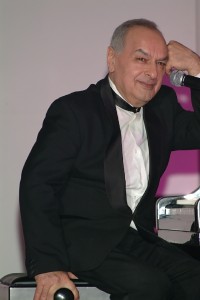 - Have you come to America for concerts or on vacation to see your daughters and granddaughters?
- I decided to take a concert break because I will not be able to visit them for a long time due to the busy concert schedule.
- Listening to your performances as a pianist and entertainer, seeing how much temperament you put into these concerts, the question arises, do you have the energy to live off stage?
- Of course, when I put my temperament into my work, I get more than I give. The dedication of the audience feeds the energy of the artist. And sometimes it is not temperament that is required, but only skill – these are the concerts that bring the most pleasure.
- Your incredible career as an accompanist pianist and showman is an absolute exception. After all, it is no secret that students studying at the CMC, and then at the conservatory, are oriented to a solo career; an ensemble or accompanist is often perceived as a creative failure.
- I have to object. If there was anything we were focused on, it was on endless pursuits. To heal the fear of the stage, we were let out as often as possible. At concerts and tests sat all the professors. In principle, it is like in sports: a habit, immunity to fear of the public should develop, and healthy excitement and excitement should remain.
- Many journalists repeat the story of how you, a winner of several piano competitions, at one point changed the direction of your career: You were asked to replace a sick concertmaster in a performance held in the Hall of Columns, after which you decided to change the role. To be honest, this version seems strange to me. It is hard to believe that after so many years in the classics, just one performance, albeit on such a prestigious stage, could change your life so dramatically. Something's wrong here...
- Yeah, it really happened a little differently. No, the concert, in the Hall of Columns, where I accompanied tenor Mikhail Alexandrovich, replacing the sick pianist, really was. But I started working with soloists a long time ago. We did a lot of ensemble play at school, at school, and at the conservatory.
- Wait, why did you even need music school? You studied at CMS, after which you could enter the conservatory directly. And for some reason you did such a zigzag.
- School is a school: form, childhood and no professional diploma giving the right to work. School is about adulthood, freedom, and at the same time responsibility. So after the eighth grade, I went to the Merzlyakov Music School, and then to the Ippolitov-Ivanov School for my teacher. Even then I was asked to accompany in class, so the practice of accompaniment I have accumulated solid, and interestingly – unconscious, and when I had to play in concerts, I had no problems, because I knew almost everything. And in the concert organization, I began to work in the years of studying at the school, and I entered the conservatory as an already working and touring concertmaster. So you're right, the decision didn't come up spontaneously in the Hall of Columns.
- I wonder how teachers perceived this change in their careers.
- I had great teachers. For example, for the first year and a half at the conservatory, I studied under Vladimir Vladimirovich Sofronitsky, studied the composition in the class of Yuri Alexandrovich Shaporin. And my fellow students became world-famous musicians: Natasha Gutman, Vika Postnikova, Volodya Krainev, Tanya Hakobyan, Kolya Petrov (he was a course older). I've never left a classic. I can still play Beethoven’s Third and Fourth Concertos, Mozart’s Concertos, Rachmaninoff’s first concert in the middle of the night, at 72.
- What did Sofronitsky advise students?
- He used to say, “If you have free time, go to the piano and read unfamiliar works, then play sketches, and then do what you want.” And this is really wise advice, because reading from a sheet develops not only finger fluency, but also the brain.
- In order to be an ensemble, and not just a joint performance, you and the vocalist must be on the same wavelength. Was there a time when one wave did not work?
- I will allow myself to note indiscreetly: no one argued with me about the interpretation of the performance.
- Does a singer need a music education?
- Absolutely. Today, there are too many people among pop artists who do not know the notes well. But you know, there are nuggets with such an inner flair that it is impossible to learn in any conservatory. You know what I mean?
- Sure. It's like an innate algorithm. After all, in literature – the same thing: a diploma of a literate is not a guarantee of taste, talent and ability to compose.
- Agreed. However, I must add that when a musician without education plays or sings what is required, he is worthless. But if he starts to lead professionals, that’s a problem. Classical education is always good. Classic helps me to play, but prevents me from writing music.
- Why? Do you catch yourself involuntarily plagiarizing?
- Exactly. All who really studied, zombie listened and learned music. The example of many famous pop songs shows that the authors voluntarily or unwittingly borrowed themes from the classics.
- For example.
- For example, the third part of the sixth sonata of Beethoven and the football march of Blanter.
- Well, the classics were borrowed from the classics, too, and unintentionally.
- Of course, Beethoven has bits from Bach, and Wagner does too.
- It turns out that the less education, the less chance of deliberate borrowing.
- On the one hand, so, and on the other hand, the fewer educated people there are, the more intellectual music there is. And then, when everyone who knows and loves the classics dies out, Igor Krutoy will be considered a genius composer.
- Working with young artists, do you see the connection between generations? Is there a difference between Soviet pop and show business?
- Unfortunately, those who are looking for new music do not find it, because America and England set the tone in terms of a new sound, and for many decades these countries have dictated their taste. As for modern Russian show composers, they sold their souls to the devil. There was an era of Soviet song, which began with the songs of the Pokrass brothers and ended with the genius Mark Minkov. There are solitary masterpieces happening now.
- And let me ask you the “question to fill up”: who according to the results of the popular vote, the media called the “chief hitmaker” of the country?
- Who?
- Hitmaker. This is a new word in the Russian dictionary.
- I assume Matvienko.
- Right!
- As an experienced seller, he knows exactly what the buyer needs. In general, Igor Matvienko is a very respected figure among the producers.
- Among the producers, of course. And here, casually, name a song that in your opinion is a real hit.
- Well, for example, "Kalina Red" by Jan Frenkel, which many considered and consider a folk song. She had an accident at the time. The great conductor Evgeny Svetlanov, who, by the way, was a brilliant pianist: he had huge hands, huge brains and in general intelligence was enough for four, wrote “Russian Symphony”, in the second part of which he used the theme “Kalina Red” with a footnote – a Russian folk song. In the hallway of the House of Composers, he was once met by Frenkel and reproached – you could at least point to the author of this “folk” song.
- Who's the author?
Me.
You know, that's a compliment to the author.
- Sure. Especially when a composer with an “original Russian” name, Jan Abramovich Frenkel, writes a song that is sung in every collective farm and at all feasts. But since you remembered Svetlanov, I confess, I did not know that he was such a good pianist.
- Come on! If he had set out to pursue a career as a pianist, few would have been able to compete with him.
- Perhaps, when a person is gifted with multifaceted talent, it is more difficult for him to choose. That's how you think that if he didn't become the head of the GASO, he might have lived longer.
- Yes, this orchestra, or rather, his initiative group, survived Svetlanova, and soon he had a heart attack.
- History tends to repeat itself. Mark Gorenstein, who for nine years stood at the head of the GASO and who, by the way, was the initiator of naming the orchestra named after Svetlanov, also survived, and also with a scandal.
Gorenstein is a very good musician, a fanatically devoted conductor, and moreover, a great tutor. He is an orchestral violinist himself, and therefore he knows how to sharpen strokes; he knows exactly what he wants from the orchestrators and knows how to achieve it. I went to rehearsals and saw how professional he was. Another thing is that he is rude to musicians, but Svetlanov also had not the easiest character.
- Let's go back to the stage. How do you explain this oversupply of music and lack of quality?
- It all depends on demand. What is the demand, is the product. It's nothing new. I will say without exaggeration, I was personally acquainted with all Soviet composers and songwriters. For two and a half years I wrote claviers to Mark Fradkin, I was friends with Jan Frenkel, I was very close to the brilliant Lena Derbenov and Igor Shaferan, also an amazing poet. I have someone to compare with, so I will answer your question this way: firstly, Russia no longer has that cultural education, and secondly, Russia needs censorship, because this country cannot live without it. When an announcer on central radio or television does not know the declinations of numerals, and moreover, does not even understand what it is about when they try to correct it, it is alarming. And so in everything, and music is no exception: what used to be nonsense has now become almost the norm.
- Well, since you are talking about the norms of the Russian language, I want to remind you of an episode from last year’s Minutes of Glory, when Alexander Shirvindt, sitting on the jury, corrected Alexander Oleshko, who said “excitingly”. Shirvindt clearly and quite harshly explained that there is no such word in the Russian language, and there is – “exciting”. I thought that after such a public “flogging”, it is impossible not to remember the correct version, however, a few transmissions later Oleshko, as if nothing had happened, “excitingly” led the transmission. What does that mean?
- Sasha Oleshko is not a fool at all, and if he repeated a mistake, then he was told that he could.
- A couple of months ago I did an interview with Alla Ioshpe and Stakhan Rakhimov. Stakhan Mamajanovich said that young, unknown performers today are even more difficult to break into the big stage than in the days of the unforgettable Lapin. Is that really true?
- It was always hard. But I assure you that a talented person who consistently goes to the goal will break through. And if he quit, then there was not enough will.
- You have said in many interviews that what you value most about musicians and actors is professionalism. Please describe the components of this concept.
- If we talk about vocalists, it is pure intonation, good diction, artistry, sense of proportion, that is, taste, and understanding of what he does on stage.
- Well, then explain your words: “I don’t believe people for a long time, but what Vaenga does makes me trust.” But you can't help hearing it when it doesn't hit the notes, can you?
- Well, I wouldn't go to her concert, but what she's doing to the people who buy tickets for her, and the five talented songs she's written, are respectable. Here Viktor Topaller tortured me, how can you listen to such vulgarity as Stas Mikhailov? I replied: “You don’t like his songs, and neither do I, but let’s not deny the fact that Mikhailov, coming here to America, made 16 sold-outs, which is impossible for any of the modern Russian artists.”
- Once, while visiting, I watched the reaction of my friend, who watched on TV the broadcast of the concert Stas Mikhailov. I thought then that audiences, especially women, perceive artists not with their ears, but with hormones. That is why, without condemning anyone, I am fully aware of the phenomenon of sixteen sold-outs.
- Yeah? That's beyond my comprehension. But people buy tickets. So the masses need it and therefore have a right to exist.
- We are not talking about the right to exist. I just want to understand some things. For example, who suggested to Maxim Galkin that he can and should sing without having a musical ear? He is so helplessly trying to get into the tonality that it causes not even irritation, but pity? It's embarrassing to look at it, and even more so to listen.
- First, 95 percent of the public does not notice these “roosters”. Secondly, Galkin never studied music, and fits to notes mathematically.
- How's that?
- Unfortunately, he is not a very musical person and does not understand that he sings impurely simply because he does not hear it.
- In one of your interviews, you said that only Oleg Anofriev and Lyudmila Gurchenko possessed pathological musical hearing and universal abilities. And how does pathological hearing differ from absolute, and bright abilities from universal?
- Here I was taught music, and I only learned to play by ear by the age of twenty. And Oleg Anofriev, like Lyusya Gurchenko, did not study at a music school and, nevertheless, approached the piano and selected absolutely correct harmonies. Oleg did not even need to sing; he went on stage and sang. A little old-fashioned, though. Remember, in such a slightly rocked voice. And Lyudmila Markovna with her own special manner. They bow low.
- You have worked with almost all famous theater and pop artists: Claudia Shulzhenko, Isabella Yurieva, Andrei Mironov, Mark Bernes, Lev Leshchenko, Joseph Kobzon, Vladimir Vinokur – you can not list all in the newspaper format. Do you think a singer should be able to leave the stage in time?
- I know what you mean. But if we talk about theatrical actors, there is 90-year-old Vladimir Abramovich Etush, whose play I recently went to. There played Yuri Yakovlev, who recently turned 85, and Lyuda Maksakova. This is a play-essay where only old people play. But how they play. It's perfect game. You know, it's very individual. Here is Ira Miroshnichenko, a wonderful actress, but she no longer plays - she just hangs out, flashes in different shows. And there is Vera Kuzminichna Vasilyeva, who in her 80-plus brilliantly plays both in the theater and in the entreprise. In general, Vera Kuzminichna is a completely exceptional person: she is always friendly, never disturbs anyone, but always goes her own way. She lived her whole life with the wrong husband and in the wrong theater. It was created not for the Theater of Satire, but for the Small.
And if you go back to the question of pop artists, then there are also aging in different ways. Some continue to bring joy and benefit, while others, although they have already loudly announced their departure from the stage, press with a heavy load, and even with aplomb.
- Asking about the timely departure from the stage, I thought about Muslim Magomayev, who did not want to grow old in front of his admirers. In my opinion, this act, first of all, speaks about the dignity of the artist.
- Yes, I knew Muslim, we played together, in '73 we went on tour to the Far East. Magomayev was exceptionally gifted by nature, had a unique lyrical baritone, excellent hearing, artistry, played the piano perfectly. Is it right that he left and is it right that those who sing before 80 are doing it? Probably not. But Iosif Kobzon is 76, and he is not a very healthy person, Lev Leshchenko is 71, and they continue to sing, and the voice sounds, and the people go.
- The fact that people are coming is not an indicator. They would also buy tickets for Magomayev until the last day. Here, it seems to me, the matter is in your own bar and the inability to fall below the once established height.
- It's not just that. The nineties were not easy to survive. Magomayev should wait out this period of powerlessness, devastation, lack of demand. He has not lost his form, he has lost his will, and it seems to me that he did not leave, but locked himself in. But by association, another artist, a famous opera singer - Alexander Voroshilo, who suddenly lost his voice. Do you know what a shock this is for the singer? For some time Voroshilo continued to work, but then I realized that this should not be done. He went into business and has no regrets.
- You are familiar with many artists and writers known for their pranks: Vinokur, Arkanov, Shirvindt. You probably didn’t stay away either. Can you remember the most successful joke?
- Actually, I'm pretty smart, even though I'm a musician. Of course, I can come up with a prank, but I always feel sorry for the victim in advance. Here, for example, we played the late Zhenya Martynov. It was in Mexico during the Universiade. Arkanov and Vinokur and I were passing Zhenya's room while he was singing. And I suggested that Winokour call on behalf of some foreign producer. He called and very convincingly offered to record some songs in the studio. Zhenya believed and half an hour "showed" on the phone his songs.
- You hurt yourself when you found out?
- Nope. And best of all knew how to play Nikita Bogoslovsky. He would be 100 years old this year. You know that famous tower crane case?
- Nope.
- Bogoslovsky invited guests to him, and he lived then on the 14th floor of a high-rise building. It's an important detail. Nikita Vladimirovich agreed in advance with the builders, who at the right time adjusted the crane. Well, the guests are sitting at the table. Theologian knocked on the balcony door, his wife opened, he went into the room and so carelessly threw back into the space: “Tomorrow the helicopter by ten!” Everyone's terrified, and he's cool. Equanimity is the main thing in the joke.
- Have you learned something with age that would be good to know in your youth?
- Experience! Lifelike and professional. It only comes with years.
- What is the professional experience of an accompanist?
- That's when it says "flute solo," and you automatically play quieter.
- What topics do you prefer at a table in good company?
- Good company is my family: my wife, two daughters with husbands, with whom we are now visiting, and three granddaughters. And if we talk about the company of friends, it's like a joke: at work, foresters talk about drinking, and at drinking - about work. But actually, I prefer solitude.
- What do you lack time for?
- On myself, on sports, on appearance. Instead of living a healthy lifestyle, especially considering my age, I’m always on the road. And with them there are many inconveniences in terms of regime, nutrition. However, no one has yet proven that a measured lifestyle guarantees longevity.
- I wish you a creative and physical longevity.
Interviewed by Zoe Master