December 1, 2007
To Create Beauty
This interview was originally conducted in Russian. This is an AI-generated English translation.
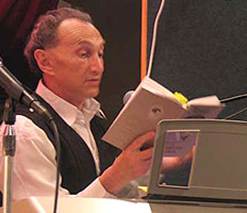 Vladimir Levy is a writer whose books “Me and Us”, “The Hunt for Thought”, “Alone with Yourself” in the far 80s we exchanged on book markets and reread until the binding fell off. Vladimir Levy is a psychotherapist who, with his inherent talent, grace and irony, opened the way to self-knowledge for a dense Soviet reader in this sense, tried to teach him to look at himself from the outside and get rid of what prevented him from living, communicating and being a happy, confident person.
– Vladimir Lvovich, who are you, a psychotherapist with many years of experience, a pessimist or an optimist?
– Do you remember the difference between an optimist and a pessimist?
A glass filled to the middle is half full for the optimist and half empty for the pessimist. So for me personally, this is the glass, if you mean life, and empty and full at the same time. In other words, I resolutely reject the black-and-white Procrustean bed of self-definition as pessimist or optimist: not either-or, but both-and. Moreover, I strive to pull out of this bed, or rather, puddle, and my reader and go with him into the spiritual multidimensionality, where there is a sense of the tragedy of being, and a sense of its infinite value and delight in life.
– Can we say that the hypnotist works exclusively with the unconscious in man?
– Not exclusively, but inclusively. Consciousness and subconsciousness are rather conventional terms denoting different layers of our spiritual integrity. They are related approximately as the front and underside of the same clothing. And if we talk about psychotherapy and hypnosis, then the relationship of the patient and the doctor (or psychologist) begins with the learned consciousness of the myth (or socially accepted and individually refracted stereotype) about what psychotherapy is, what hypnosis is and whether it exists at all. The path to the subconscious is laid through consciousness, and to the consciousness through the subconscious, these are continuously communicating vessels.
– In one of your interviews, you said, The frustration of the soul takes revenge cruelly. In comparison, the loss of professionalism is a trifle.
Personally, I totally agree with you. However, over the years, I increasingly see that “fat-skinned”, poorly read, uninterested people look happier than those who are constantly improving and delving into themselves.
So maybe it is the training of the soul that takes revenge cruelly?
– I think you are transferring the context of what I said earlier to a completely different reality. I don’t remember exactly what I said in that interview, but apparently it was about training the soul of the therapist and his professionalism. But I think I agree with you that a pig who chucks at his trough looks happier than, say, a composer who looks in his sweat for a single right note for his work.
– Sometimes irritating non-punctuality, non-compulsoryness, grudging of those with whom you have to communicate in life. What to do: re-educate others or yourself?
– I will answer the question with a question, using as a model the animal already mentioned in the previous answer: if you work, and also live on a pig farm, and you do not like the smells, sounds and behavior of your wards, who is easier to re-educate: them or yourself? The chances of success of one or the other, in my opinion, are easy to weigh.
– Some people manage to change their habits. I have never met anyone who has changed their character. For example, stop being hot-tempered, or, on the contrary, passive and phlegmatic. An envious person, if he is intelligent, can learn to hide his feelings, but he will hardly cease to be jealous. Have you ever seen a radical change in the character of people in one direction or another?
– Yes, I have noticed such changes, and quite often. But as a rule, they do not occur overnight or by their own volitional decision, but after many years, sometimes decades, as a result of the addition of many active forces. These forces act both from the inside (some kind of hidden inner work, the accumulation of life-spiritual experience, passing from quantity to a new quality; sometimes, perhaps, some changes in the body, hormonal changes ...) - and from the outside: serious blows of fate, life shocks, losses and gains.
My observation is that 75 percent of people are potentially capable of such radical character changes – often, however, not for the better. And the remaining 25 percent remain almost the same from birth until the end of life.
– Why do some people give everything without difficulty, while others, no less gifted, have to make huge efforts to achieve their goals and often without result?
- This question of yours evoked a vivid memory of one of Pushkin’s small tragedies, namely Mozart and Salieri, where one of the heroes, it is easy to remember who exactly, asks exactly this question.
Who is more gifted and who is less, you agree, it is not always easy to determine, and, in the end, it is the results, the fruits of the work. At the same time, let us not forget about the constant addition or, conversely, the minus of giftedness as such and character, of the personality as a whole. In The Color of Fate and The Car of Luck, I described in detail the difference between the characters of people in different relationships with fate. With equally good, say, hearing and musical abilities, one may have the character of the Pamper of Destiny, the other – the Fatal Fighter, the third – the Adventurer, the fourth – the Buckled. Accordingly, the professional fate of these people, other things being equal, will be different.
– With age, experiencing the departure of parents, a person begins to fear the inevitability of death. Or rather, fear and helplessness before possible physical suffering. Deep believers are calmer, wiser approach this issue. But how do we, raised in atheism, morally prepare ourselves for leaving: ignore this topic, believe in reincarnation?
Are you a religious man? What can you, as a psychologist, advise?
– An atheistic or religious view of the world does not yet predetermine a person’s attitude to leaving life. I have seen both people who profess one religion or another, who are not at all free from the panicked fear of death, and those who consider themselves atheists, and at the same time have a perfectly calm and firm attitude towards death, as something, though inevitable, but insignificant. What is decisive in this is the personality rather than the worldview, as well as whether a person feels his life, and therefore death, filled with some imperishable meaning.
There are different paths of spiritual development, and there are different alternatives to the seemingly meaningless nature of our inevitable death. And it is not a fact that those brought up in atheism need to remain in this atheism all century without moving anywhere from it.
The experience of humanity in relation to the passing of life is huge, the experience of various religions, spiritual practices, and artistic, philosophical, and simply human, everyday. “To philosophize is to learn to die,” was said in ancient times. We can say that living means learning to die, and we can learn from all of humanity. Anyone who is open to thoughts and souls has from where to draw spiritual strength for this inevitable transition. It is enough, for example, to read Seneca’s Moral Letters to Lucilius. There, in the most lively, accessible and deepest form, on almost every page, training is conducted to accept death as a natural end of life, as its finale, what the finale of a musical work can be.
I am not in favor of ignoring the subject of death and avoiding it defensively, as is customary in our present civilization. I am for a deep study of this topic, study from a young age, but step by step.
– There’s a lot of talk about how to manage the future in dreams. What do you think of that?
– What will not come up with to frown gullible, naive, ignorant people, which in the world, alas, the vast majority. You can only manage what you know, what you understand, what you have studied, one way or another, by experience. And the mysterious realm of dreams is one of the least studied spheres of life and, as far as I know, no scientifically reliable ways of controlling dreams, much less the future through dreams, have yet been invented.
A person can control his future within limited limits, about as much as you can control the development of a chess game – to the extent that you can calculate or intuitively predict possible options for the course of events, if these options are associated with some freedom of choice of certain “moves”. And a lot depends on the general attitude – how you program yourself, how you feel and how you behave – so choose the course of events. Sleep and dreams can also be involved in this self-adjustment process, while at the same time providing important in-depth information about what can happen and how to behave better. As Leo Tolstoy noted, deep down we know much more than we can imagine and express, and the dream helps us to imagine and express the unimaginable and ineffable, showing it to us now in vivid concrete, then in symbolic forms. Therefore, one who is attentive to life in general, and to dreams in particular, is in closer contact with the future than a superficial person. This is perhaps the only rational seed that can be extracted from the charlatan formula “the management of the future in dreams.”
– In retrospect, what was the happiest time of your life, and do you consider yourself a fully realized person in terms of your career and personal life?
– The happiest time of my life is the one I live in right now. Although there is much that has already happened, I cannot complain. I want to make it clear that I try to feel the time of my life as a whole, without dividing it into separate parts, I try to live in one place. full time, But that doesn't always work. A fully realized person, in my opinion, can only be considered a corpse.
– How would you define the purpose and mission of man on earth?
– To create beauty in the fullest sense of the word, in other words, to be a co-creator of the Creator.