November 5, 2016
Sacred Voice
This interview was originally conducted in Russian. This is an AI-generated English translation.
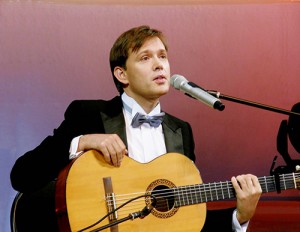
Interview with Oleg Pogudin
 “I have never understood the art of sacred music, but now my hearing has discerned in it a secret voice.”
I loved in her that dream and those souls of my excitement that all the former beauty of the Wave bring from oblivion.
To the sounds of the past rises and the loved ones seem clear: It is my dream that sings, it blows a mystery of beauty.
Alexander Blok.
One who once heard this voice will remember and distinguish it from all others, thanks to the unique timbre, which is deservedly called silver. In November of this year, Honored Artist of Russia Oleg Pogudin for the first time comes on tour in the United States. The artist’s repertoire includes Russian ancient and classical romance, urban and folk songs, works from the repertoire of A. Vertinsky, B. Okudzhava, P. Leshchenko, as well as vocal works by foreign authors.
- Oleg, tell me, what, in your opinion, is the main value of Russian romance?
- There are several components: expressive melody, simple poetry, but the main value is sincerity. In a romance, as in a city song, the performer can express himself as much as possible without fear that he will not take a high note due to poor health or fatigue.
- You're talking about everyday romance, not technically more difficult for a vocalist, classical, right?
- Yes, it is about everyday romance and urban song. In this genre, the range and saturation of the voice are not the main components; the performer can achieve success due to his charm, emotionality. But if you add good vocals to this, everyday romance can rise to the level of academic singing.
- As you say, sincerity is the main thing, and I remembered the words of Oscar Wilde: “Sincerity in small doses is dangerous, and in large doses it is deadly.” He was talking about human relationships, not the stage. But don’t you think that with its apparent simplicity and ease of execution, romance is more dangerous for the performer than even an operatic aria, because excessive sincerity borders on vulgarity?
- You're absolutely right. You need a sense of proportion. Basically, art is a sense of proportion. By the way, it is good that it is present not only in romance, but also in the opera. And romance is a genre so fragile that with insufficient giftedness of the performer or carelessness of performance, romance ceases to be a high art. You see, in the romances of Rachmaninov, Tchaikovsky, Dargomyzhsky, Glinka, you can hide behind the genius of the musical material, but this is impossible in urban romance.
- I mean, to sing professionally: to take all the right notes, take your breath in time, follow the nuances and remember the words?
- Sing exactly what the author wrote. However, captivating melodies of urban romance reach their peak and become priceless precisely when the performer exposes the soul. Without the emotional component of urban romance can not exist.
- Other performers are so overwhelmed with emotions that they forget about the existence of piano, believing that the louder you sing, the longer the applause.
- It is a question of talent and skill. Although, someone "takes" vocals, someone acting talent, and someone in addition to these qualities, there is an unmistakable taste, a sense of genre, and this is an innate gift. But for any artist it is important that in his life there were teachers who passed on his culture, knowledge and ability to learn.
- As far as I know, your vocal teacher at the Leningrad Institute of Theatre, Music and Cinematography was Eduard Hill. We all know and remember him as a popular singer. I wonder if he was as optimistic as he was on stage.
- Yes, but at the same time a very deep, superbly educated, kind, friendly and generous person to help. You know, competition in the world of pop is quite mean, and the situation when a venerable artist himself offers help to a beginner is a rare case. And he knew how to love people, appreciate all the good, despite the deprivation of orphanage childhood.
- Maybe that’s why he was able to enjoy life. - Maybe. It is interesting that before we met him, although I heard songs in his performance, I did not feel delight. Delight came from communicating with him as a person.
- And a teacher? - Yes, of course, but still, if we talk about a vocal teacher, the main name here is Galina Vishnevskaya, with whom I studied for four years, until she left.
- Was she your teacher or consultant?
- A teacher. I asked for her as a student myself. We met in 1999 at the ceremony of awarding the Tsarskoye Selo Art Prize.
- I must say, you were then in a wonderful company of laureates: Mstislav Rostropovich, Valery Gergiev, Yuri Lyubimov ...
- At this ceremony, each of the winners had to speak. And imagine my astonishment when, after I performed the romance, Galina Pavlovna gets up, famous for her royal gesture, asks for attention and says that she listened to a tape with my records in New York, which a friend gave her, and considers my voice unique.
- And the room froze.
- And so did I, because her gesture shocked me. In terms of support, it was a royal gift, without which much would not have happened.
- Do you mean your current position on the Russian stage?
– Yeah. I mean reviews from people of this magnitude. After 10 years, I asked her to come to the Opera Singing Center because I felt the need to restore my academic vocal form.
Galina Vishnevskaya is known for her uncompromisingness, the habit of saying to the face what she considered necessary. As a teacher, did she spare the students' self-esteem?
- Her charm and professionalism ruled out the possibility of resentment and even more conflict. She was a person of such magnitude that everything she offered was invaluable.
- The fact that the modern audience of romance consists of people over 40 years old, has anything to do with our current way of life?
- I think it's connected. I am 44 years old and 22 of them are on the professional stage. At the same time, I have the feeling that I am just beginning to live, although at my concerts I see audiences who are not just younger than me, they are a different generation. There are fewer of them than older people, but there are. The fact that the rhythm of our lives has desperately accelerated is a fact. And romance has its own tempo rhythm, with which modern realities cannot coexist. Most of us live in a bustle and already perceive it as a normal life. We get used to doing everything in low-emotional, extremely specific and rational, and romance, like any lyrical work about love, belongs to the field of irrational. It's a non-fussy genre. Therefore, to a person who has never seriously touched classical music, ancient architecture, literature and painting, romance can seem dull, unmodern, sad, even tedious.
- Listening to romances in your performance, first of all, you notice the exceptional purity of intonation, the calibration of every nuance, every phrase. How do you feel about improvisation, on stage and in life?
- On stage, I feel very positive about improvisation because it is a certain degree of freedom, and in art, freedom is a necessary thing. At least it's desirable to me. Without it, it becomes stuffy, like with a lack of oxygen. But I have to repeat the well-known truth that any improvisation must be well prepared. That doesn't mean rehearsed. Just good improvisation requires a lot of experience in this genre. Then it can surprise, delight, and not cause confusion.
- Are you capable of unexpected things for yourself and others?
- I try to control the situation and myself. There is a time and place for improvisation. For example, I am one of the few real freelancers on the Russian stage.
- That is, you are free to do what you want, sing what you like and exist solely for your earnings.
- Exactly. Now it would be boring and difficult to be in a rigid framework of external management, as, for example, during my time at the BDT (Big Drama Theater), where I got immediately after graduating from the theater institute.
- Can you remember one of the improvisations?
I consider my departure from BDT to be a huge improvisation. It was a leap into the unknown.
- Tell me...
- It happened in '93. I graduated from the Institute in the nineties and immediately got into this famous theater, a real fortress, a battleship, which, as everyone thought, could pass through any storms. It turned out that the 90s were the beginning of the collapse of the empire. Georgy Alexandrovich Tovstonogov was no longer alive, but all the great artists, all the workshops were still operating and were full of strength. Everything was at its peak – or at the beginning of its decline. After two years there, I realized that I was not in my place. Although, the word understoodIn this case, inaccurate, because I didn't come to this conclusion as a result of reflection and conclusions, I just began to languish. And it wasn’t about tiny episodic roles, but the fact that in my solo guitar performances for a variety of people – from conscripts to academics or foreigners who were just starting to come to Russia – I was able to do something very, very serious. I felt that I could instantly reach the hearts of other people, even those who did not know Russian and did not understand what I was singing about. I felt that I was losing not only time, but also my creative life, and therefore I had to take a step. In violation of all traditions, I went to Kirill Yurievich Lavrov, then the artistic director, and asked for my release.
- Was the meeting peaceful?
- He said goodbye that the doors of the theatre would remain open to me.
- Where did you go?
- Nowhere. I had my first tour abroad, in Sweden. In two weeks I gave twenty-eight concerts. And this is for a foreign-speaking public, in a country where, due to historical circumstances, Russia is treated rather wary.
- It was in the early nineties. And now, touring in Europe, do you also notice a wary attitude towards Russia?
- Yes, and it is justified, as bitter as it is to admit it.
- Explain if I may.
- You know, in the '90s, I spent a lot of time performing and living in Europe. Now I live less often, but I tour no less. From about the second half of the 90s, the contingent of people who, unfortunately, are not the best representatives of the country went to Europe. I say that with regret. I confess that sometimes, in certain circumstances, I try not to show that I am Russian. At least from the first word.
- Why is that? Who exactly are you talking about?
- About the nouveau riches, with their wild habits, rudeness, arrogance, often absolute contempt for European culture or culture in general.
- In a recent interview on the program "Called Guest", the journalist said about you the following: "He (O.P.) is distinguished by impeccable artistic taste, subtle knowledge of the material, as well as a truly St. Petersburg aristocracy." If you asked me how Oleg Pogudin differs from other vocalists of the chamber genre, I would first of all note the unique timbre of the voice. Do you agree with me?
- I agree, though, to some it may seem immodest. But the singer is primarily natural data. In general, I never set out to compare myself to other performers in terms of greatness or “greatness.” But the timbre of my voice is really unique. Then there’s another important point: I perform other people’s texts as if they were created by me. On stage, I feel like a poet. Someone is born to sing oratorios, opera, and my psychophysics coincides with romance.
- Isn’t there a time when you’re sitting at an opera house and you think, ‘I could sing this tenor part better?’
- No, because I know what I can do. But I confess that opera is my love and one of life’s sorrows.
- Didn't happen?
- A tenor career in opera did not happen. But even now, as the years have passed, I sometimes think, what a blessing that I am not serving in that system. First of all, when I look at what's going on in the opera, I mean the trend. modernized productions. Secondly, because I am my own boss, which is a wonderful feeling. The scope of the opera house is incredibly restrictive.
- You literally repeated the words of Muslim Magomayev – this is the framework he spoke about when he was asked about the reason for giving up his opera career.
Muslim Magometovich is one of the most fantastic singers. He was an artist of incredible talent and amazing taste. It is clear that such a singer will no longer be, but thank God that he was.
- Did you know him and Tamara Sinyavskaya?
- Unfortunately, no. But I happened to find out how she felt about me when the impresario I wanted to meet said that he had agreed to talk to me only because Tamara Ilyinichna had advised him to pay attention to me. Such an act, when an artist, a celebrity, helps another artist not even at his request, even without being familiar with him, says a lot about the personality of a person.
- In a 2012 interview with Anastasia Kozlova, you said the following: For an artist to face an ideological machine is not worse. I try to dodge all this, because fighting alone is hard, and participating is not always worthy. In September of the same year, you accepted the offer to become an adviser to the President on cultural affairs. Was it inconvenient to refuse, or did this position attract you?
– Let's correct: not as an adviser to the president, but as a member of the president's council for culture and the arts are different things. One of the President’s cultural advisers is Vladimir Ilyich Tolstoy, and the Council itself is an advisory organization with no financial or power. So it's not a position. Also, have you seen how many decent people are on this board? To be among them, and especially to cooperate, is cultural happiness.
- Yes, of course, I read who is part of this organization – it is really the color of Russian art: V. Spivakov, Y. Bashmet, V. Gergiev, E. Mironov, O. Tabakov, A. Kalyagin, Father Tikhon – all those who supported Vladimir Putin during his election campaign. Who specifically invited you to join this star cast?
- Directly, the invitation was voiced by people whom I really appreciate and love – these are the heads of literary museums-reserves. I have known them for twenty years and we have gone through both difficult and happy periods together. For me, these people are the measure of morality and artistic taste. Therefore, doubts about whether to accept this offer were very short-lived.
- What are the responsibilities of members of this Council? Who and what do they advise? - In fact, it is an advisory body that develops a common opinion and recommendations, which are then brought to the President. He decides whether to reckon with them. For me, the greatest joy is that many practical issues are solved. These may be the simplest things, but in Russia, for some reason, they require the intervention of “higher forces.” For example, we can talk about district Palaces of Culture in some small, abandoned towns, music schools, children’s choirs, festivals, which survive only thanks to enthusiasts who give their time, and in fact – life. In Russia, in this sense, little has changed since the days of Gogol and Saltykov-Shchedrin. The same arbitrariness or misunderstanding, not always intentional, of some petty princely officials. And this is especially disappointing because Russia is incredibly rich in talent. And there are times when you are approached, and you have the opportunity to convey this request.
- Upstairs. - Yeah, and there's a lot of decent people out there. I want to clarify: I am not engaged in politics, but the work to protect and develop Russian culture is my direct responsibility. So, answering your question, I am not at all in conflict with what I said: I do not go into politics, I do not participate in it and I do not intend to do it, because I have a sad conviction that there is no pure politics.
- I would add that regardless of the country and political system.
- Politics is a set of compromises, a curse rather than a desirable occupation. Taking control of peoples, cities, even theaters is a heavy burden. Therefore, when people in power remain true to their ideals, they are respected.
- What if ideals are initially questionable?
- Modern man tends to question almost everything. It is worse when one’s own ambitions are passed off for caring for people. The human world is too fragile, and I am against the fact that the ambitions of some people, the concrete lives of others, collapse.
- Do you have any regrets?
- Yes, about my mistakes, my imperfections, the good things that could have been done but not done. It's not a pose. I understand that there are no people without flaws, that it is impossible to live life without making mistakes. Initially, there are no saints, just as there are no absolute villains and scoundrels. Everyone has reasons for regret. But it is important that a person suffers by committing a bad deed, and knows how to rejoice in the good that is in him and in people.
- I don’t even know how to respond to those words. If you take them literally, then in your opinion it turns out that a person who has committed meanness, it is enough to regret it, suffer a little, after which you can consider yourself worthy of respect and rejoice that in his soul there were remnants of conscience?
- Well, why so categorical?
- I can't do otherwise. I see and understand that there are people who are blatantly mean, intent on evil, and enjoy committing violence, killing, humiliating others.
- There are no bad people in the beginning; there are circumstances. If a person allows himself to do evil from time to time, then he can certainly reach the state of an absolute monster. But initially there is something good in each of us.
- Unfortunately, for many, kindness and humanity remain in their infancy. How much does a creative person need ambition?
- Absolutely necessary. The main thing is that they do not destroy conscience.
- You once said that the artist lives, in a sense, according to the monastic charter, that the life of a vocalist who devoted his life to the stage is sometimes ascetic. Where is the line that you could not cross even for the sake of art?
- I am afraid to answer such questions even to myself, because man assumes and God disposes. This applies to everything, including the trials that a person can withstand. Therefore, it is better not to make any vows or oaths if you are not ready to justify them. I don't know how long I'll last, and the further I live, the less I know. But I would absolutely not want to overstep my principles, betray my ideals for the sake of some creative victories. To date, what I do on stage is exactly what I do in life.
- How do you respond to criticism?
- Very painful. And I'm hot-tempered. That's my flaw. Knowing this, I am used to besieging myself, so hotly do not respond to what seems unfair to me, but try to think and understand the cause of what happened.
- Well, here I came across a video where Avdotya Smirnova in the program “School of slander” talked about you as a sample of “candy and haberdashery” vulgarity. No offense? There was no desire to answer, especially since it was said behind the eyes, and even through the central channel?
– I saw a passage of that show and was stunned. However, this episode has nothing to do with criticism. Rather, it is a manifestation of ordinary ignorance and domestic rudeness. Ms. Smirnova and I have never met, I think she did not see me in the eye and at my concerts have not been. Why she scolded me in a program dedicated to another performer (Petro Nalich – Z.M.) is a mystery to me. As far as I understand, the program was on the record, but this episode still did not feel necessary to cut.
– Smirnova admitted that she, in principle, does not like the “sweet-sweet” tenor, and specifically in you – “romantic face”. A strange statement for a man who considers himself a music lover.
- I'm inclined to think it was some kind of personal problem, because the attack sounded ridiculous. It seems to me that at that moment a person could have been simply unwell, and I am sorry if I was the cause of this illness.
- Have you been invited to some shows, for example, “Universal Artist”, “Two Stars” – as a participant or on the jury? Why can't you be seen on Channel One?
- Why?
- At least, for two reasons. First of all, it is prestigious in terms of reaching the mass audience and growing popularity. Secondly, based on the first, so more chances to get the title of People's Artist.
- You know, I feel very organically on the channel “Culture”, but if they call on the First, I, of course, will not refuse, although somehow to force it, I do not consider it necessary. Not out of snobbery. There is such a thing as the moment of correspondence, and I would not like to appear on the First channel in some unusual role.
- What are you reading?
- I haven’t read much lately, and I admit it with sadness. The last thing I read from serious literature was Zola's "Germinal."
- Is that a random choice?
- Absolutely. I haven’t read anything before, so I chose the first one. And read - like the books of all great writers, she does not let go. As far as modern literature is concerned, talking to me about it is completely useless. She's passing me by, and I'll be honest, that's the position. In my opinion, modern writers constantly reflect, write exclusively about themselves, and to me their experiences, torment, throwing seem very parochial.
- Well, in fact, every writer, great or ordinary, to some extent, writes about himself. It's different how he writes. And isn't the mining town immortalized by the great Zola a place?
- I would not like to be suspected of arrogance and snobbery. Speaking of parochialism, I meant the mediocre thinking of a person who is interested only in himself and his personal problems.
- What is more important in the modern world – creation or destruction?
- The first emotional reaction is, of course, destruction. At the same time, I understand that my answer is the result of the influence of news programs. About two years ago, I realized that I began to perceive the world through the lens of the screen. That's not normal. Negativity prevails on the screen, and often it is also served with savor, with some perverted pleasure. And I think it's a problem. I have great respect for journalists, but I am increasingly annoyed by how irresponsible and subjectively they comment on what is happening in the world. Twenty years ago, when the era of free speech began, journalists were mindful of the responsibility for what they reported and how they expressed themselves. They thought about the consequences of what was said. Looks like it's cancelled now.
- This is not just a problem for Russian media.
- But there are important things that cannot be thrown out of life without destroying life itself. So I believe that as long as children are born, the creative takes precedence over the destructive.
- Is romanticism still there? You know, I was puzzled by the idea that terrorism is one of the manifestations of romanticism. You said, "Terrorism is scary, but it's romantic if the person involved is honest and doesn't make money from it." Could you please explain what you meant? For example, how are the terrorists who blew up the Twin Towers for an idea and not for money romantic?
- Let's agree on terms. In the modern world, the word terrorism has acquired a special meaning. If you accidentally say it on the phone, you can wait for the police. It's no longer a free concept. I definitely do not accept murder, especially for ideological reasons. I talked about the fragile line that separates human fantasies and terrifying reality. And terrorism, like romanticism, can seem mysterious, fascinating, terrible. Remember Dostoevsky’s Demons, remember Pushkin’s romanticism. And the dark abyss on the edge, remember the Russian bombers of the late 19th century.
- Maybe it's better not to look at them at night.
- I guess. They believed in beauty, they were romantic, but they became terrorists. It is terrible when people flirt and cross the boundaries of fantasy, the boundaries of literature. The revolution of the 17th year is largely literary. It was attended by people who wrote novels and played in the theater. And it turned out to be so scary that in any novel or play you can not imagine such a thing. My coordinate system is the New Testament. It says, “No murderer has eternal life in him.” For me, this is an extreme watershed that cannot be crossed, just as one cannot call for the destruction of a people or an individual for the sake of some idea.
- I get it. But as far as I know, you have repeatedly toured in Israel, talked about the indelible impression Jerusalem has made on you and the grateful listeners you have found there. But these listeners, their children or parents, can be witnesses or victims of another terrorist attack every minute of the day, for which the whole world will then blame them. I mean, if, after the school bus exploded, your potential listeners read that their favorite artist equates terrorists with romantics, it would be puzzling at best.
- Yes, your point is fair. Given what is happening in the modern world, this word must be used very carefully.
- I read your words about the fact that “the current man runs in circles, forgetting where to go”. What are you looking for in 20 years?
- It's not easy for me to answer that question. I would love to sing as much as possible. Preferably for the rest of my life, because singing is my universe, my happiness. But the singer is an unhappy creature in the sense that he constantly feels that there is a limit to his physical abilities. His creative destiny is almost always shorter than his life. And I can't imagine what I'm going to do after I realize I can't sing the way I sing today, now. I am a religious person, that is another joy of existence. And most importantly, with the end of the earthly life, our existence does not end. However, those things that extend to infinity require our work here as long as we live. And this work does not depend on our everyday happiness or professional success. It depends on the state of the soul, on conscience, on the ability to love and forgive.
- Do you think there is music behind the last line?
- No doubt.
Interviewed by Zoe Master